
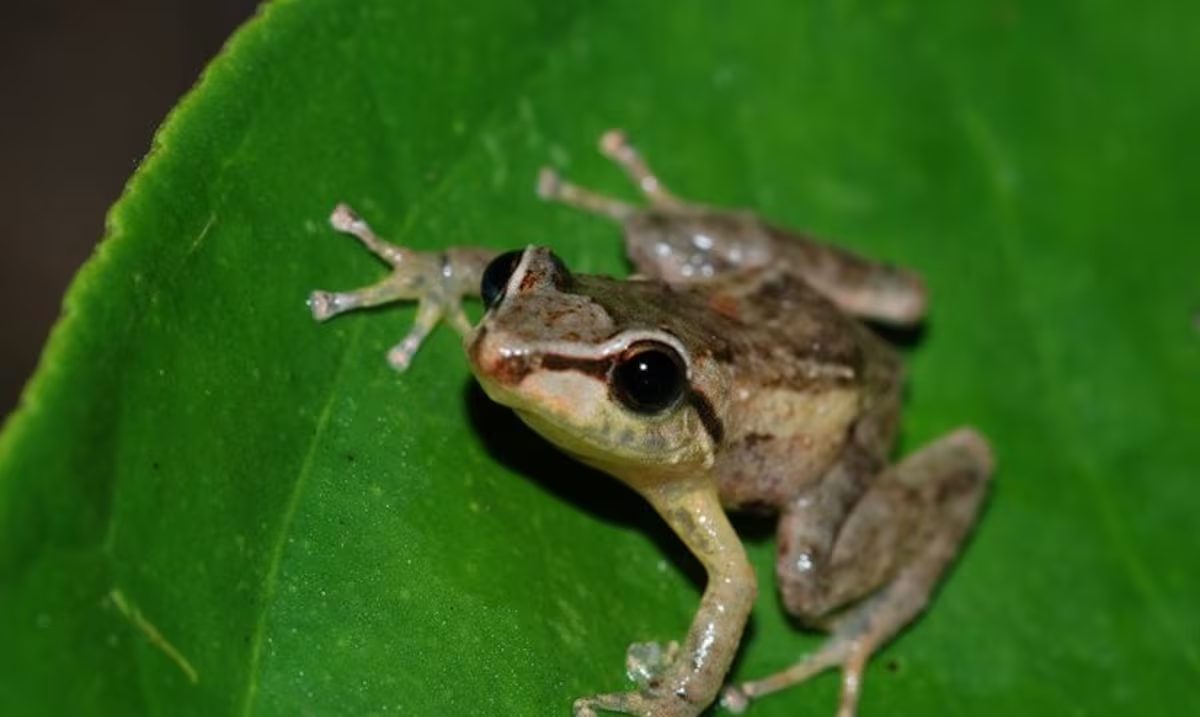
In an unprecedented effort to strengthen the ties of scientific collaboration between Puerto Rico and Hawaiithe University of Puerto Rico (UPR) in Ponce initiated an interdisciplinary research project to support responsible management strategies for common coquí populations (Eleutherodactylus coqui) on the island of Oahu.
He coquí It is an endemic species of Puerto Rico, protected and recognized as a national symbol. However, in Hawaii, it is considered an invasive species.
Expressing his support for the research, the interim rector of the UPR-Ponce, Eliezer Barrios Colonexplained that the project is subsidized by the “Hawaii Invasive Species Council” (HISC), in collaboration with the Mayagüez University Campus (RUM) of the UPR. Both units (Ponce and Mayagüez) received a grant of $85,000 to carry out the study.
The scientists in charge of the project, the doctors Alejandro Ríos Franceschi (UPR-Ponce) and José A. Carmona Negron (RUM), share common roots as they are natural Utuado.
Ríos Franceschi, ecologist and professor at the UPR-Ponce, leads the proposal that unites science, environmental sensitivity and international cooperation. Collaborating at his side is Carmona Negrón, a chemist from the RUM, who contributes his expertise in natural compounds and organic chemistry.
“This project is an example of how science can bridge communities, cultures and ecological priorities. It focuses on supporting Hawaiian state agencies in the design and evaluation of control strategies that are sustainable, safe and based on the best available science”said Ríos Franceschi, in a press release.
The strategies that are being evaluated include the use of natural compounds, the development of non-invasive reproductive methods and the study of the impact of these compounds on vegetation. These actions will be carried out in close coordination with government entities such as the Hawaii Department of Land and Natural Resources and the HISC.
In addition to collaborating with conservation agencies in Hawaii to understand coquí behavior in island environments, Puerto Rican scientists are also tackling similar problems in their native archipelago. As part of the project, preliminary tests are carried out in Puerto Rico, using the Cuban frog (Osteopilus septentrionalis), a local invasive species. This strategy allows testing management tools with lower risk, generating local data and simultaneously contributing to island conservation in multiple geographic contexts.
“An important part of our work is carried out in Puerto Rico, under controlled conditions in UPR-Ponce and UPR-Mayagüez laboratories, to guarantee that any proposed solution is ethical, effective and environmentally safe”said Carmona Negron.
This project positions the UPR-Ponce as an emerging center of applied research in conservation, ecology and biological control. The collaboration with the RUM, as well as with Hawaiian agencies, reinforces the scientific capacity of Puerto Rico and demonstrates the potential of its researchers on the international stage. Both Ríos Franceschi and Carmona Negrón highlighted the importance of respecting the cultural and ecological values of Hawaii and Puerto Rico.
“The coquí is part of our identity, and we approach this work with a deep ethical and scientific responsibility. This project focuses on the ecological understanding of invasive species, particularly the common coqui in Hawaii, promoting adaptive management strategies grounded in science, conservation, and international collaboration.. Our work seeks to generate applicable knowledge and sustainable solutions through respect for the ecosystems both in Puerto Rico and the Pacific Islands,” concluded Ríos Franceschi.