
Google improves the responses that Gemini can give with a new capacity that will interest those who ask the chatbot questions educational or scientific research. The company is rolling out an update that adds support for interactive 3D models and simulationswhich the user can now generate with a prompt.
Gemini already offered interactive diagramsbut the novelty announced by Google represents a leap from those visualizations, which can be clicked to obtain more information about certain elements, to 3D models and simulations that can be manipulated in real timewith variables that the user can modify on the fly to better understand the topic they are researching.
It can be used to explore, for example, how simulate a complex physical system, spin a molecule or watch the Moon orbit the Earthwithout being limited to a fixed diagram. In the case of the Moon, for example, you can adjust the initial speed and intensity of gravity using manual sliders to see how these variables create a stable orbit.
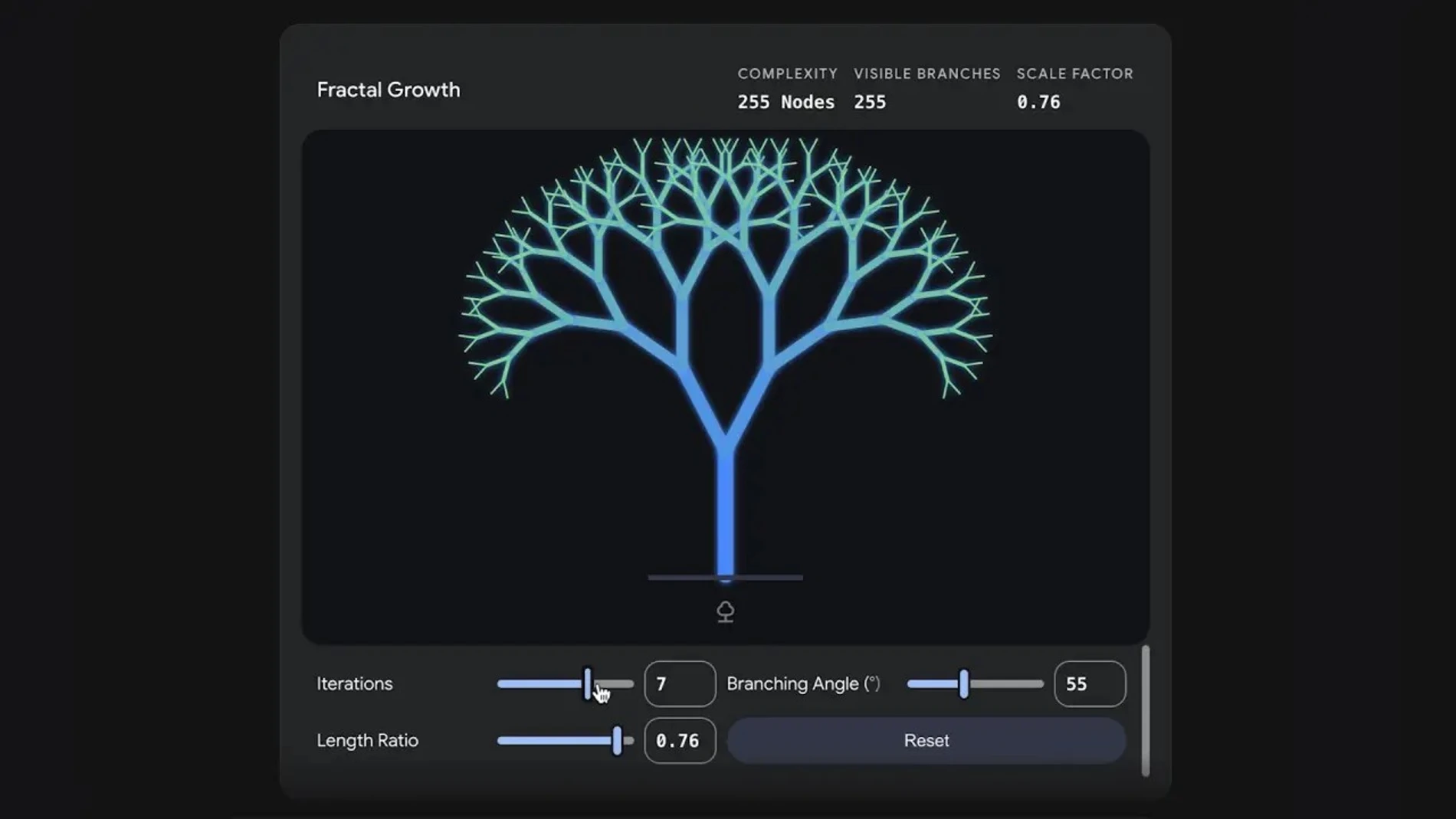
To use this feature, you must be a Google AI Pro subscriber. Start the instruction or prompt with the expressions ‘Show me’ either ‘Help me visualize’complete it and then select the button ‘Show me the visualization’. You can enter prompts such as: ‘Visualize how fractals work’ to view fractal growth and modify attributes such as branching angle, length ratio, and number of iterations.
You can also explore quantum physics concepts asking ‘Show me how a double slit experiment works’ and Gemini will give you options to change the wavelength, wave speed, and slit spacing, so you can see the waves changing in real time.
Google notes in a blog post that support for simulations and 3D models in Gemini is being rolled out globally for Google AI Pro subscribers, except for those with Education and Workspace accounts.
This update comes shortly after Anthropic have given to Claude the ability to respond with graphs, diagrams, and other interactive visuals. OpenAI has also added to ChatGPT a feature that allows you to generate visualizations of math and science concepts.