
There the heat must have been stifling and the crew must have been exhausted after thousands of kilometers into the unknown. To go a little further, even one step, was to enter another dimension. And yet, they did it. Vasco Nuñez de Balboa reached the top of the mountain and, for the first time, saw a new horizon for Europe: the Pacific Ocean. It was noon on September 25, 1513 and had taken a step towards eternity. More than 500 years later, humanity returns to the Pacific after a trip that we will not forget either. First it was the border of the sea and now it is like a void.
There, where the Earth seems to expand until it blends with the sky, the Orion capsule of the Artemis II mission landed, closing a journey that has not only been technical, but deeply symbolic: the return of humanity to the vicinity of the Moon, farther than anyone had traveled in more than half a century.
On board, four astronauts who, for a few days, carried with them more than just scientific instrumentation: they traveled with the memory of all generations of explorers, space, terrestrial and marine. Technical data is the facts. During its trajectory, the ship reached distances that had not been recorded since the times of the Apollo Program, breaking the record for humans furthest from Earth, a fact that, beyond the numerical, has some emotional vertigo. Because getting so far from the planet is not just a matter of kilometers; It is a way to break, even for a few moments, the invisible cord that ties us to our origin. And it raises a disturbing question: how far do we have to be from the Earth to stop being its inhabitants, to stop being human?
The return, however, is where epic meets physics. Returning home from lunar orbit means facing one of the greatest challenges in space engineering: atmospheric reentry at hypersonic speeds. The Orion capsule entered the Earth’s atmosphere at about 40,000 kilometers per hour (enough to travel the entire circumference of the planet in one hour), which is equivalent to more than 11 kilometers per second. At that speed, the air in front of the ship does not move gently aside: it is violently compressed, generating temperatures that can exceed 2,700 degrees Celsius, hotter than the lava from many volcanoes. The same layer that protects us from meteorites and disintegrates them is the “shield” that the capsule had to defy to return.
In the case of Orion, it is an ablative system based on advanced materials derived from Avcoat (a compound of silica fibers and special epoxy resin), designed to burn in a controlled manner during reentry. Far from being a failure, this erosion is its function: each layer that comes off takes with it part of the heat, protecting the internal structure of the capsule and, with it, the lives of its occupants.
NASA has insisted on multiple occasions on the importance of this system. “The heat shield is the crew’s first and last line of defense,” those responsible for the mission have stated in official statements. It is not an exaggerated metaphor. Unlike other phases of flight, there is no room for correction during reentry.: everything happens in a matter of minutes (13 in this case), in a precise choreography where any deviation can have catastrophic consequences.
To reduce thermal and structural loads, Orion employs a technique known as “skip reentry.” Instead of passing through the atmosphere in one go, the capsule makes a first foray, partially bounces to higher layers and re-enters again. This profile allows energy to be dissipated more gradually, reducing G-forces on the crew and improving landing point accuracy.
Inside the ship, as the outside turns into an incandescent plasma, the astronauts rely on another layer of protection: their suits. The system used on Artemis II, known as the Orion Crew Survival System, is designed not only for launch, but also for reentry and possible emergencies. These are pressurized suits, with cooling circuits, integrated communication systems and the ability to keep the astronaut alive in case of depressurization. During reentry, when G-forces increase and the capsule vibrates under thermal stress, these suits become an extension of the vehicle itself: a final frontier between the human body and the hostile vacuum of space.
And yet, even amidst that technical complexity, there is something deeply human about the moment of return. Communications with Earth are interrupted for several minutes due to the plasma that surrounds the capsule, a silence known as blackout.. During that interval, the astronauts are, in a sense, alone. It is a suspended and contradictory moment: the greatest technology, the same one that takes us to the Moon, loses the battle with physical reality and only trust remains in everything that has been built before.
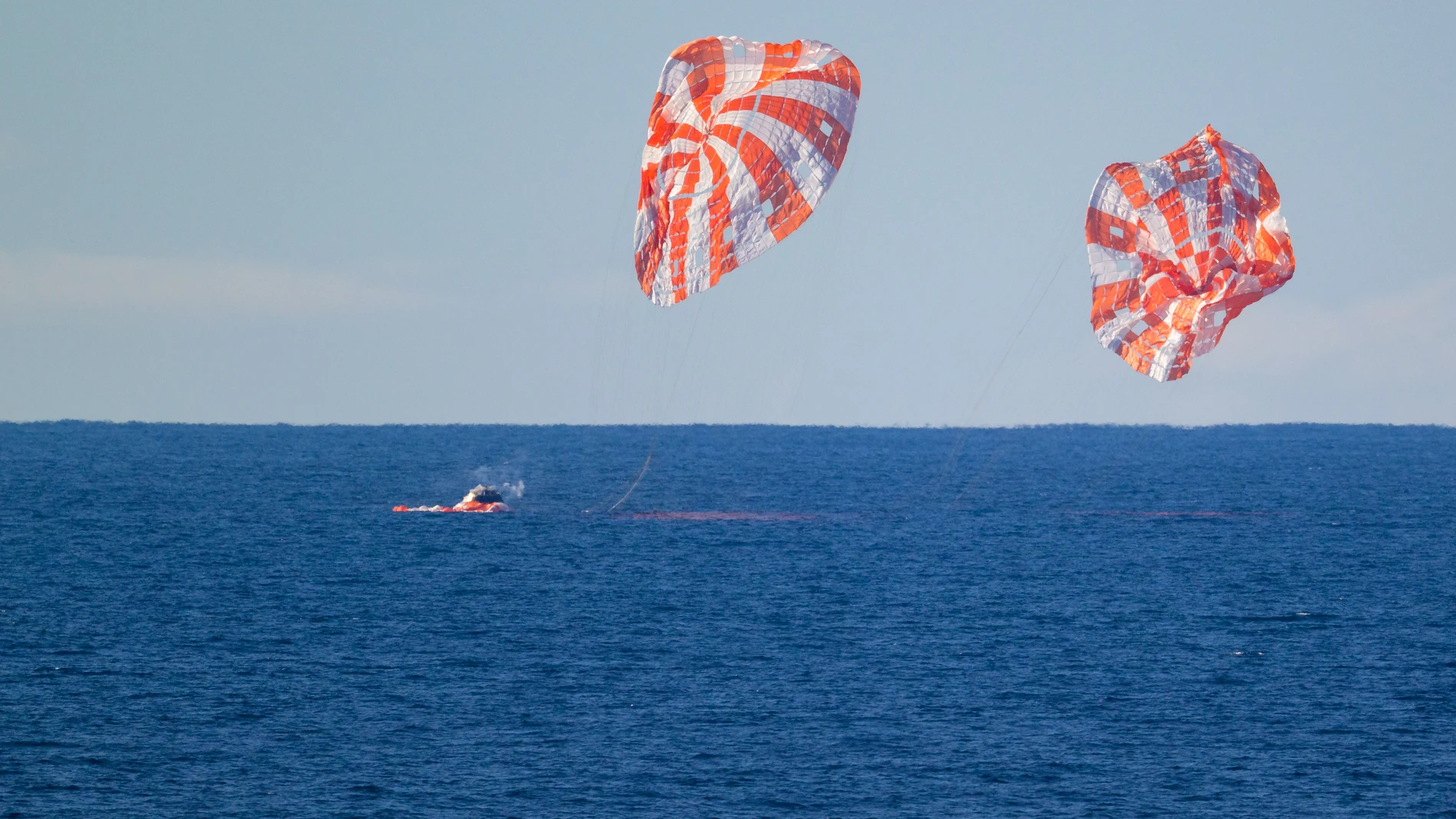
When the signal returns, it is accompanied by a parachute that is already deployed over the ocean. The speed decreases, the roar turns into rolling, and finally, the soft impact of splashdown. Water. Silence. Home.
In its first statements after the return, NASA stressed not only the technical success of the mission, but its value as a preliminary step towards future manned moon landings. Artemis II has not set foot on the lunar surface, but it has tested each of the systems necessary to do so. “This is the beginning of a new era of exploration,” the agency noted, insisting that the ultimate goal is to establish a sustainable presence on the Moon and, eventually, use it as a platform for missions to Mars.
But perhaps the most important thing is not found in the official statements, but in what this trip represents. For decades, deep space had remained a memory, a glorious but closed page of history. Artemis II reopens it. And it does so at a time when humanity, more than ever, needs horizons.
Because there is something about the idea of traveling further than anyone has gone before that transcends science and engineering. It is a way of saying that there are still unanswered questions, paths uncharted, stories to be written. That knowledge is not a closed territory, but a frontier in constant expansion.
The Artemis II astronauts have not only orbited the Moon. They have carried with them the gaze of millions of people, especially those who are still deciding what they want to be. In every image of the Earth seen from a distance (small, blue, fragile) There is an implicit invitation: to take care of our planet, yes, but also that, like the Orion crew, the rest of humanity, we are also passengers. In every way.
Sometimes we think of exploration as a destination, an end point to reach. The Moon, Mars, the stars. But missions like Artemis II remind us that true value is on the path. In the process of building, precisely when everything around us leads us to the antonym. Maybe that’s why, when we think about how far humanity has come, we shouldn’t just measure it in kilometers. Perhaps the true distance is that between settling for the known and daring to explore the unknown. Artemis II has traveled both. And he just came back to tell it.
And what he says appeals to our essence as a species. The word moon has its etymological origin in losna either leuksna: shine, luminous. We are fireflies in the cosmos. We are attracted to light and brightness and we live in a constant balance, perhaps in vertigo, of not knowing whether to fall or rise. The first is almost always individual. Elevating ourselves, however, hides a plural that not everyone sees. Like fireflies.