
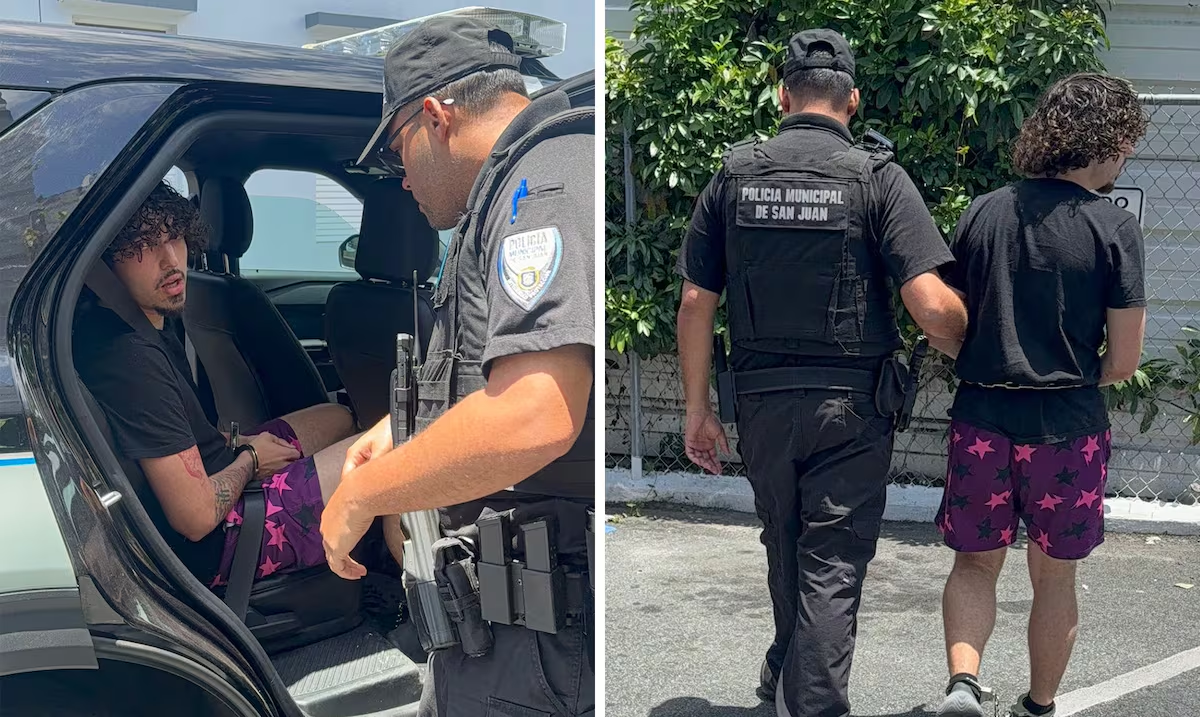
The judge Dayra Infante Bosquesof the Court of San Juan, found cause for arrest against Alexis J. Martínez Arizala, a 22-year-old tourist, for offering false information to a police agent. San Juan Municipal Police in an incident in which the accused used a video manipulated through artificial intelligence (AI).
He Department of Justice indicated, in written statements, that the prosecutor Christian Alexis Castro Plaza filed a charge against the accused for violation of Article 268 of the Penal Codefalse statement and/or allegation about a crime, in its serious form.
Infante Bosques analyzed the evidence and found cause for arrest, while setting bail at $15,000, which Martínez Arizala did not post. The accused will remain in custody until April 22, when the preliminary hearing will be held.
Martínez Arizala published a video on his account instagram in which he entered a fast food restaurant and showed a municipal agent a video showing the alleged theft of his patrol car. The agent and his partner went out to the parking lot and saw that the patrol car was where they parked it.
There was already an arrest warrant issued in the state of Florida for a similar case against Martínez Arizala.
The agent arrested Martínez Arizala after the defendant explained that it was a prank with a video modified by AI.
The commissioner of the Municipal Police of San Juan, John Jacksonstated, earlier in the day, that his agents would complete the process of filing additional evidence requested by the Prosecutor’s Office.
“We are requesting a search warrant for some cameras that were in the place, and another search warrant for the individual’s cell phone,” the officer explained at the time. “Once we have all the evidence, it will be filed. We understand that it will be today afternoon.”
“He dedicates himself to this and creates content about it. In Florida he has other charges filed for a prank on a police officer similar to the one he did here,” he added.
Jackson also explained that, once he is processed in Puerto Rico, federal marshals will extradite him to Florida to process the pending arrest warrant in that state.
He faces three years in prison
In the San Juan case, Jackson said he faces three years in prison for one of the charges he will face, alleging violation of article 268 of the Penal Code of Puerto Rico.
Article 268 maintains that “any person who, through a complaint, request, information, confidence, regardless of whether it is anonymous or under a false name, addressed to persons or officials with authority under the law to carry out investigations of a criminal nature, declares or falsely alleges, having knowledge of its falsehood, that a crime has been committed, thus causing the initiation of an investigation aimed at clarifying it, will incur a less serious crime.”
“If the falsely alleged fact is one that constitutes a serious crime, the person will incur a serious crime and will be punished with imprisonment for a fixed term of three (3) years”, adds the article.
Meanwhile, Jackson said that they are still investigating to find out if they will eventually file additional charges for other alleged pranks with similar false information that he made to other municipal agents, as seen in videos published on their social networks.
The officer added that charges may be filed against a second person who allegedly cooperated with Martínez Arizala.
The facts
According to preliminary information, on April 6, Martínez Arizala allegedly approached an agent of the San Juan Municipal Police who was in a fast food restaurant in Santurce and showed him a video altered by artificial intelligence, in which it appeared that another person had stolen his patrol car.
According to a statement from the Municipality of San Juan, the police officer reacted immediately to what he understood to be a real situation.
Later, Martínez Arizala would have told him that it was a joke, while he recorded the entire situation in a video that he later published on social networks.
Martínez Arizala and the other subject allegedly dedicate themselves to publishing, on social networks, confrontations that they provoke with police and civilians around the United States.
Some of the incidents, presented as pranks, consist of showing videos produced using artificial intelligence making it appear that someone is driving or manipulating vehicles without authorization. In this way, they seek to provoke reactions among agents or citizens.
In other publications – also on social networks – they have captured and manipulated, with artificial intelligence tools and without authorization, images of citizens. In them, they show people carrying out actions that are not real, causing violent reactions that they also publish on social networks.