
For more than a century, the logic of underwater combat has been surprisingly simple: see without being seen… and shoot first. The weapon par excellence of that philosophy has been the torpedo. A fast, lethal, autonomous projectile designed to find its target and destroy it. From models like the Mark 48, capable of splitting a boat in two, to its most modern versions, the torpedo has been the underwater equivalent of a perfect bullet. But that logic is starting to change. Not because the torpedo has stopped being effective. But because it is no longer enough.
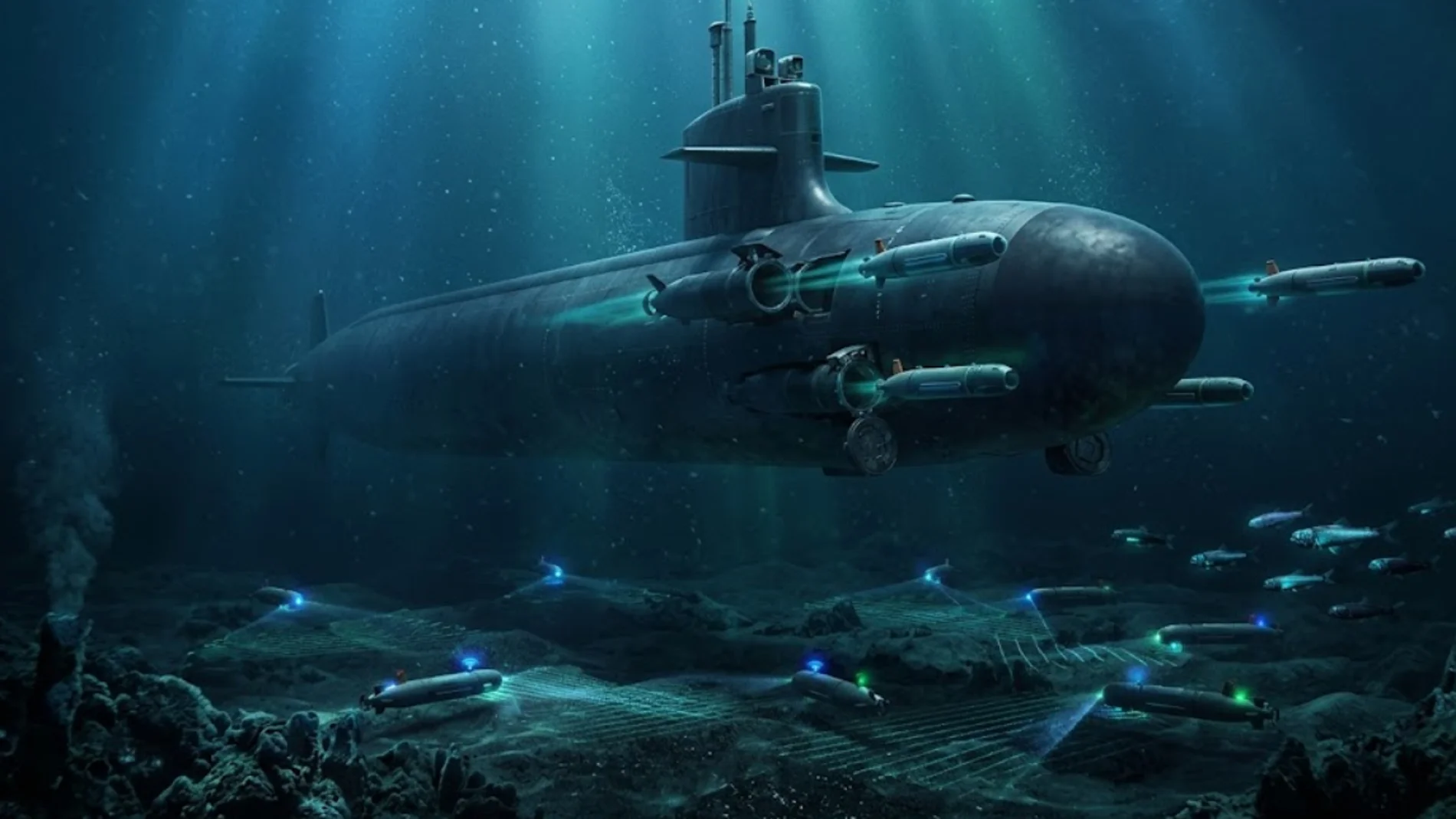
The twist begins with a seemingly simple idea: what if instead of firing a gun, we deployed a system? The US Navy is moving in that direction with autonomous underwater vehicles that can be launched and, most importantly, recover, from the submarines’ own torpedo tubes. And this is an important detail.Because those tubes, designed for decades to launch single-use weapons, now become entry and exit doors for reusable, programmable and, above all, intelligent machines.
But… are they really underwater drones? The reality is that they are not simple remote-controlled robots. They are autonomous systems capable of navigating, making limited decisions and adapting to their environment. In technical parlance they are known as autonomous underwater vehicles (AUVs), an evolution of the old ROVs (remotely operated vehicles). The difference is key: the latter is a remote control car, while the AUV is more like a car that knows where it is going.
These systems can map the seabed, detect threats, spy on infrastructure or even coordinate with each other through acoustic communications. And this is what another of the great challenges of the underwater world is based on: underwater there is no GPS, there is no WiFi, there is no easy communication. And yet, these “drones” are beginning to operate as networks.
But the real change is the persistence of this technology. A torpedo has a mission and a time: it is launched, searched, hits or fails. End. An underwater drone introduces something completely different: persistence. You can stay for hours, days or even longer in an area, observing, waiting, collecting data. Some prototypes are even designed to “hibernate” on the seabed and activate when necessary.
And, if that were not enough, the next step is even more radical. These drones can not only observe: they can also act. Some current designs can carry sensors, deploy other drones, or even launch torpedoes themselves after covertly arriving in an area of operations. That is, the torpedo does not disappear: it becomes a piece within an ecosystem.
There is another factor that explains this shift: cost. Traditional torpedoes are extremely expensive and complex. The new drones, on the other hand, are designed to be produced in large quantities, even hundreds or thousands of units. So, Instead of single, scarce and valuable platforms, a model closer to that of swarms appears: many, relatively cheap systems, capable of saturating, monitoring or attacking in a coordinated manner. And with this, underwater warfare begins to look more and more like drone warfare in the air.