
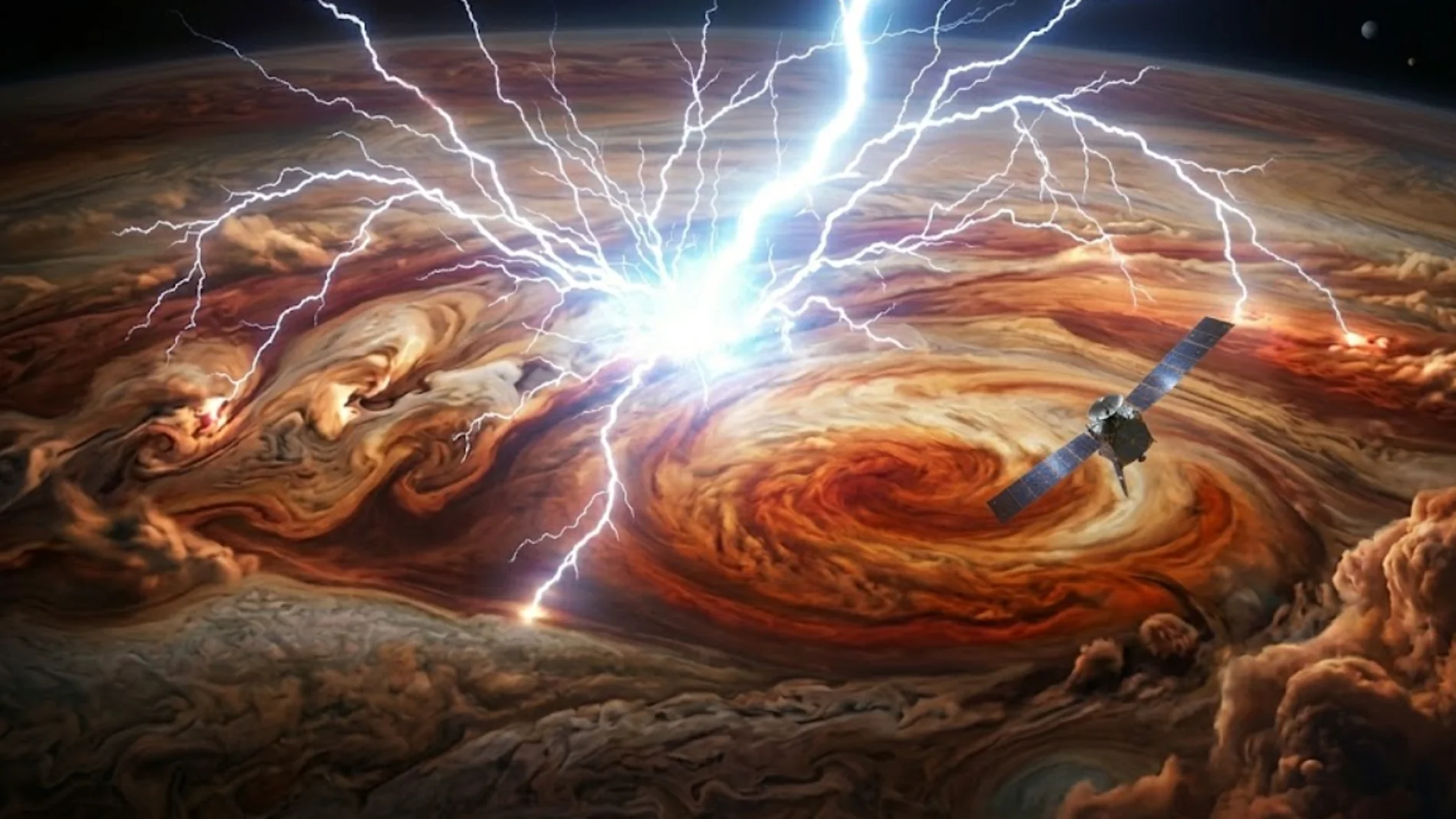
For centuries, lightning has been an intuitive measure of nature’s power. On Earth, lightning can light up the sky, split a tree or fuel the fantasy of enormous energy for a few seconds. But even that image falls short when one looks toward Jupiter. There, the storms are not only bigger. They are another category. And now, thanks to Juno, we begin to understand to what extent.
Since arriving at the planet in 2016, Juno has been orbiting through its clouds, traversing storm belts that can last for months or even centuries. But what has changed recently is not that we have seen more lightning, but that for the first time we have been able to measure it accurately. And that has altered the scale of the problem. A team of scientists, led by Michael Wong has discovered that some rays on Jupiter are much more powerful than those on Earth. And it is not a rhetorical exaggeration: we are talking about discharges that, in energetic terms, could reach between hundreds and thousands of times the energy of a typical terrestrial lightning bolt.
For decades, the idea that Jupiter had gigantic lightning bolts was already on the table. The first probes detected them as intense flashes on the night side of the planet. But there was a problem: we only saw the brightest, the most extreme. It was like trying to understand Earth’s storms by observing only the most spectacular lightning strikes.
Juno has changed that because it doesn’t “watch” lightning like a camera, but like a radio. Its microwave radiometer detects invisible emissions that pass through clouds, allowing the real power of the discharges to be measured without being hidden by the atmosphere.And in doing so, it has revealed something more interesting than strength: diversity. Not all lightning on Jupiter is monstrous. Some are comparable to terrestrial ones. But others… play in another league.
On Earth, storms work because moist air rises: water vapor is lighter than dry air, making it easier for clouds to grow and accumulate electrical charge. The opposite happens on Jupiter. Its atmosphere is dominated by hydrogen, and the humid air there is heavier, making it much more difficult for a storm to rise.This means that when a storm manages to grow, it does so after accumulating an enormous amount of energy. And when that energy is released, it is much more violent. It is, in a way, a storm that has had to “work harder” to exist… and that, therefore, discharges with more intensity.
Added to this is another key difference: scale. Storms on Jupiter can reach more than 100 kilometers in height, compared to approximately 10 kilometers for those on Earth. More height means more distance to separate electrical charges. And more distance means more voltage.But there is something even more interesting in the finding of Wong’s team, published in AGU Advances. It’s not just about understanding Jupiter, but about understanding Earth better.
Because, surprising as it may seem, we still know relatively little about lightning here. In recent years, scientists have discovered electrical phenomena in the upper atmosphere (such as “sprites” or “ELVEs” or elves that we are only beginning to understand). Studying Jupiter allows us to observe these processes under extreme conditions, as if the planet acted as a natural laboratory on a giant scale.
And that is where the Juno mission begins to give us important clues. A clue to how atmospheres work, how energy moves on a planet and, ultimately, how phenomena that we think are familiar, Like a storm, they can completely transform when the rules of the environment change. On Earth, lightning lasts a fraction of a second, while on Jupiter, it can be the echo of a storm that has been brewing for months.
To make these findings, Wong’s team relied on several orbits made between 2021 and 2022. During that period, Juno flew over twelve isolated storms, and in four of them it was close enough to measure the microwave static of lightning. Flashes averaged three per second during these flybys; In one of them, Juno detected 206 different pulses of microwave radiation.
From a total of 613 measured pulses, Wong calculated that the power ranged from that of Earth’s lightning to 100 times or more. Since Earth’s lightning emissions (at one radio wavelength) were compared to those from Jupiter (at a different wavelength), there is some uncertainty in the comparison. If we compare “radio emissions from Earth’s rays, Jupiter’s rays could have been a million times more powerful than Earth’s,” the study notes.
Converting the microwave power of a beam into total power is not simple. On our planet it is estimated that a single lightning bolt releases approximately 1 gigajoule of total energy, or one billion joules: senough to supply energy to 200 average homes for one hour. Wong estimates, in the conclusions, that the energy of a lightning bolt on Jupiter can be up to 500 and perhaps up to 10,000 times greater than that of a terrestrial lightning bolt.