
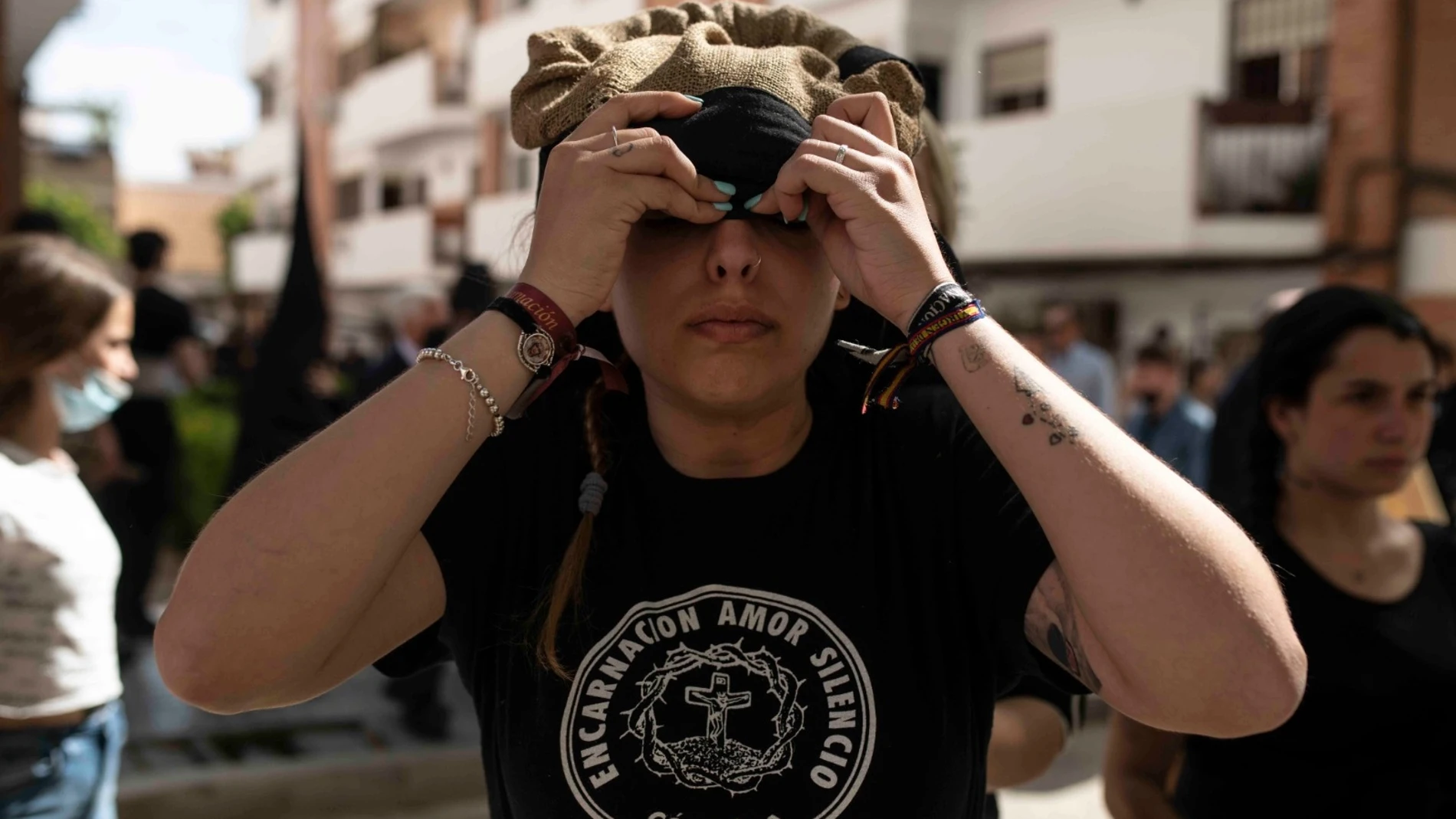
They carry Christ and the Virgin on their shoulders or on their backs in at least 421 steps in 159 municipalities, more than half of them Andalusian. Women are a minority under the steps, but they already have a voice and visibility after breaking one of the many glass ceilings of Holy Week brotherhood. This is the result of the exhaustive study carried out by the emeritus professor of Psychology at the University of Seville, Rafael Moreno Rodríguez, and professor María Jesús Cala Carrillo. Together they have published “Costaleras” (Almuzara), a work in which they address the profile of women who have decided to be something more than Nazarenas, Manolas or older sisters. «It emerged in October 2023, when I met Esperanza Bazán, a woman living in Seville. “She has been taking steps for more than twenty years, moving to other towns to carry out her work as a bearer when she cannot do so in her own,” says Moreno. The researcher is aware that they have to “move in a world largely dominated by men, in many cases reluctant and even decidedly opposed to accepting them, attitudes that some women also show.” It is visible, in light of the commotion generated in recent weeks by the refusal of the Brotherhood of the Most Pure Blood of Our Lord Jesus Christ of Sagunto to all female presence.
In their study, which is based on 400 interviews with coastal women and two years of analysis of this growing phenomenon, Cala and Moreno analyze how in forty years women have been gaining ground. Although there is no historical study to certify it, the calendar marks 1987 as the year in which women conquered the sack. This is when the Royal Brotherhood of La Expiración from the Jaén town of Jódar becomes the first brotherhood in Andalusia to incorporate mixed groups. At the same time, in Albacete, the Santa María Magdalena Brotherhood was launched, the first in Spain founded and directed only by women, although today it is also mixed.
The authors of the book highlight how, despite these references, they have to face “disqualifications, insults and humiliating treatment.” With the doors closed firmly in some brotherhoods, the investigation adds how in other brotherhoods “they hinder their work by not providing support to those they have accepted and incorporated, posing demands or requirements, perceived as not necessary, and even less so when it happens that they are not also asked of men.” In some entities, their presence is even reviewed with a magnifying glass, even when they have initially been accepted, even arbitrarily discarding them in the Igualá, the key test in which the foreman measures and organizes the costaleros by height to form the crews that will carry the steps. Nerea, a 23-year-old girl from Córdoba, reported to the National Police just a week ago the Dolores brotherhood for rejecting her to carry the Cristo de la Clemencia due to gender discrimination. The brotherhood maintains that the criteria are “strictly technical and equitable.” A year ago they already excluded her, ensuring that the group was already closed when they called the equalá.
Unfair situation
Thus, it would be of little use if the norms of the dioceses already ratified equality in brotherhoods. The most hackneyed argument for this veto? “It is said that they do not have strength, but there are more than 420 cases in which women participate, and the foremen who work with them assure that they are capable of doing it with the same technique as men, and even with greater mental strength,” the specialists write. For all these reasons, the two researchers determine that it is an “unfair situation”, especially “in Christian environments in which a principle of love for others is considered fundamental.”
The truth is that, as happens in other ecclesiastical spaces, they are the majority. This is corroborated by research by Professor Daniel Marín Gutiérrez, from the Pablo de Olavide University, who speaks of a process of feminization of brotherhoods, at least in Andalusia, the territory in which his report is limited. They represent 54.1% of those who belong or have belonged to them, he explains in his sociological x-ray of the brotherhoods.
“Although legal equality has been achieved in the last third of the 20th century and at the dawn of the 21st century, there is still a scarce presence of women in prominent roles,” she says, focusing on functions such as management positions in the government of brotherhoods, the direction of music bands, the conduct of steps and thrones or bearers, bearers and throne women. In the same way, it warns of a lack of “daily socialization within the brotherhoods.” For the sociologist, this context contributes to their “invisibilization in brotherhood” within a process aimed at “normalization.”