
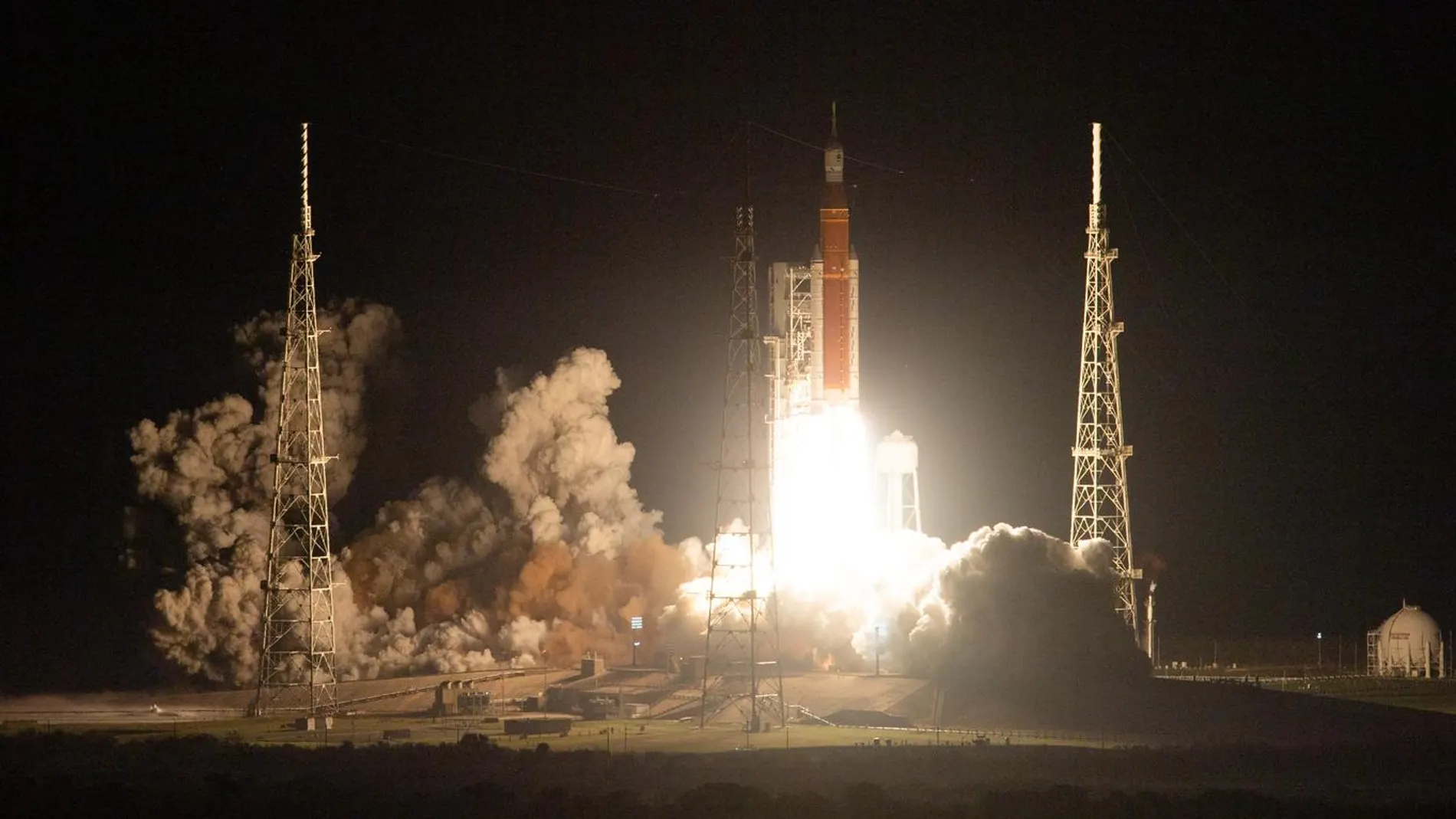
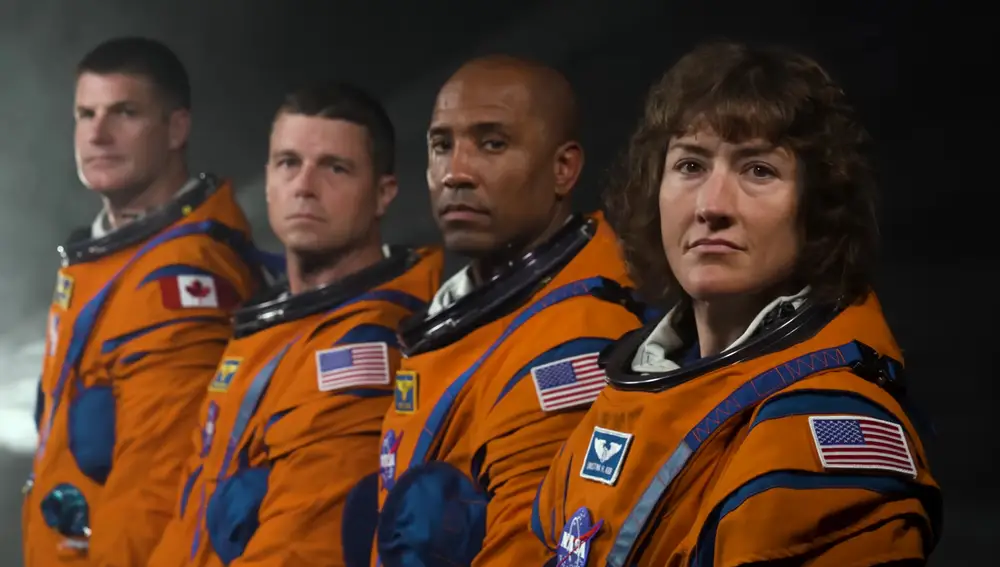
This morning, Artemis II took off heading to the moon. Aboard the Orion spacecraft, pushed by the 98 meters of the SLS rocket and 2.5 billion tons of fuel, four astronauts were preparing to do something that humanity had forgotten. Since the last Apollo mission, in 1972, no human has left low Earth orbit and that is precisely what Reid Wiseman, Victor Glover, Christina Koch and Jeremy Hansen will do in the next few hours. They departed from the Launch Complex 39B platform at 12:24 p.m. (Peninsular time) and, if everything goes as expected, they will circle the Moon at 6,000 kilometers on its dark side and land in 10 days off the coast of San Diego (California).
Thus will end one of the most exciting journeys of humanity, with a dive into the Pacific Ocean after traveling more than 1 million kilometers; the equivalent of going around the world 25 times. And it is that The Moon is much further away than we think, 380,000 kilometers above our heads. But since our simian brains resist large numbers, it is enough to notice that, between it and us, all the planets in the solar system could fit.well attached to each other, but with a gap of 4,000 kilometers in case we also want to add a second Moon (3,475 km). That is the journey that the four crew members of the Artemis II face, but the true epic is the one that is yet to come. Because NASA intends to land humans on the moon in 2028before China achieves it and Trump’s term ends. Two major pressures could compromise NASA’s safety culture and, in fact, already have set off some alarms.
Only 20% of the current population was alive when Neil Armstrong set foot on the Moon. For the other 80%, this mission, Artemis III and the possible landing of Artemis IV on the moon are something totally unheard of. And, although the Apollo program and the Artemis are not identical, the similarities go beyond the obvious. It is clear that both seek to reach the Moon, but they have another, more pragmatic objective: protecting the future of the United States. In the 60s it was the Cold War that spurred aerospace development. Placing a satellite in orbit was a good way to announce that you could also place other less peaceful objects, and putting a human on the Moon was the ultimate show of force. The animals are displayed to deter their enemies and avoid getting into a fight where even the winner can be mortally wounded.
The nuclear threat motivated the first space race, but this second seeks to ensure future space hegemony. In this era, where international law is faltering, space law is not a guarantee of anything. But even if the great powers stuck to it, they could get away with it.
It is true that, in 1967, the Treaty on outer space dictated that “Outer space, including the Moon and other celestial bodies, may not be the subject of national appropriation by claim of sovereignty, use or occupation, or in any other way”. But, at the same time it denies national appropriation, it allows its exploitation and use. “Outer space (…) will be open for exploration and use by all States without any discrimination (…) and there will be freedom of access to all regions of the celestial bodies.”
That is the reason why, in the Artemis Agreement, it speaks of “safety zones” that avoid interference between states but that, in practice, also guarantee the continuity of those exploitation rights. This means that advantage is everything and, even without sovereignty, the country that first achieves the technology necessary to deploy bases on the Moon will be able to claim the most territory. This is what the head of NASA’s Moon Base program, Carlos García-Galán, told us: “It is important to arrive first (…) if we reach an area with high scientific interest, there cannot be other countries that land nearby. Whoever reaches those strategic places first will block the rest”.
Artemis is an American program where other space agencies, such as the European or Japanese, collaborate, but it is not the only one that seeks to establish lunar bases. In front of NASA, the CNSA (China National Space Administration) is presented, which, although much less ambitious objectives are proposed, this gives robustness to its plans.. In fact, NASA’s historical competitor, the Russian Roscosmos, has joined forces with the CNSA as a result of the sanctions caused by the war in Ukraine.
As reported by the CNSA, China hopes to land two humans on the moon in 2030 and build a basic lunar station before 2035. This means that The US is still a few years ahead, but it is worth remembering that they do not pursue the same objectives (although the same territories) and that it seems likely that the delays will end up narrowing that difference.
First of all, The technology that China requires to fulfill its lunar missions is more affordable and, therefore, less prone to accumulating delays in their development. Secondly, the Chinese government system ensures the continuity of the program facing the lurches that accompany changes in legislature in the United States. And finally, in its opacity, The Chinese agency has earned a reputation for meeting deadlines. NASA, on the other hand, perhaps out of highly recommended caution, tends to postpone its launches. In fact, when the Artemis missions were announced in 2019, the goal was to land on the moon in 2024. Something that, in the best of cases, will not happen until 2028.
The game will be decided between them because, although there are more players on the board, they do not pose a real threat to the interests of the United States and China. India is the space power that follows closest to them and, however, they do not expect to land on the moon before 2040 and the first base, if everything goes as they hope, would not arrive until 2047.
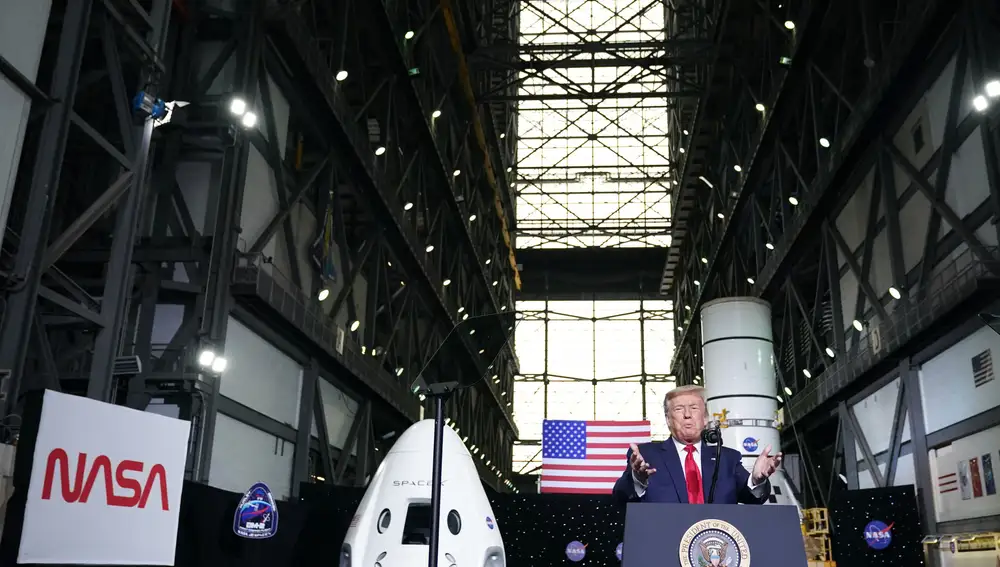
For the US, the future depends on how much advantage they manage to maintain in this space race, but to this external pressure is added another pressure that comes from within. A few days ago, the director of the US space agency, Jared Isaacman, declared that: “NASA is committed to achieving, once again, the almost impossible: returning to the Moon.” before President Trump’s term endsbuild a lunar base, establish a permanent presence and carry out other actions necessary to ensure American leadership in space.” The mention of Trump is not trivialWell, we are facing a president with a special interest in narratives and returning to the Moon is the most effective way to return America to those times that they long for, when it was still “great.”
Taking into account that Trump should leave the White House on January 20, 2029 and that Artemis IV will not land on the moon before 2028, any delay could take away a milestone that he already promised during his campaign and to which he dedicated a few words in his inauguration speech: “We will pursue our manifest destiny towards the stars, launching American astronauts to plant the Stars and Stripes flag on the planet Mars.”. Manifest destiny, the doctrine that Americans, as a chosen people, have a moral duty to spread their civilization across the wide world and, it seems, now into space as well.
On January 22, one of the most prestigious scientific research journals in the world, Science, published three articles analyzing the influence that Trump is having on American science policy. and concluded that the authoritarian and personalistic trend that the Trump administration is taking puts the independence of scientific institutions at risk.. A conclusion that is also suggested in the latest report of the Aerospace Safety Advisory Panel. In the latter, They question the safety of the upcoming Artemis missions and recommend taking the foot off the accelerator.
But the criticism of the report goes further and suggests that NASA’s safety culture may be compromised and, although they do not name Trump, the truth is that, during the last year, his government has drastically reduced the agency’s budgets and independence. External and internal pressure is concentrated on the Artemis missions and all space travel entails risks.. That means that we cannot hope for them to disappear and the question, then, is not whether governments are willing to take risks, but rather where they set the threshold and how far they can slide it in order not to lose the race.
DON’T BE KNOWN:
- It is difficult to analyze from the outside the state of NASA’s safety culture; to do so, we rely on independent panels, such as the one formed after the tragic Apollo 1 accident. Some experts, for example, are concerned about the heat shield that must protect the astronauts during their re-entry into the atmosphere, during which the ship’s fuselage can reach 2,500ºC. This suffered serious damage during the re-entry of Artemis I in 2022, but NASA has not made changes to the shield carried by Artemis II. However, space agency experts have stated that the danger can be avoided by controlling the angle at which they pass through the atmosphere.
REFERENCES (MLA):
- NASA’s First Flight With Crew Important Step on Long-Term Return to the Moon, Missions to Mars. NASA, NASA Headquarters, https://www.nasa.gov/missions/artemis/nasas-first-flight-with-crew-important-step-on-long-term-return-to-the-moon-missions-to-mars/
- Artemis II. NASA, https://www.nasa.gov/mission/artemis-ii/
- Artemis II Science. NASA, https://www.nasa.gov/humans-in-space/artemis-ii-science/
- Space Launching System Reference Guide for Artemis II. NASA, Jan. 2026, https://www.nasa.gov/wp-content/uploads/2026/01/sls-5558-artemis-ii-sls-reference-guide-final-review-508-012026.pdf?emrc=342194
- Meet NASA’s Orion Spacecraft. NASA, https://www.nasa.gov/missions/meet-nasas-orion-spacecraft/#section-1
- Reid Wiseman. NASA, https://www.nasa.gov/people/reid-wiseman/
- Victor J. Glover, Jr. NASA, https://www.nasa.gov/people/victor-j-glover-jr/
- Christina Koch. NASA, https://www.nasa.gov/people/christina-koch/
- Biography of Jeremy Hansen. Canadian Space Agency, https://www.asc-csa.gc.ca/eng/astronauts/canadian/active/bio-jeremy-hansen.asp
- Aerospace Safety Advisory Panel 2025 Annual Report. NASA, Mar. 2024, https://www.nasa.gov/wp-content/uploads/2024/03/asap-2025-annual-report-tagged.pdf
- Langin, Katie. “Pressure on the Pipeline: The Trump Administration’s Agenda Is Likely to Reshape the Scientific Workforce.” Science, 22 Jan. 2026, pp. 342-44.
- Malakoff, David. “Talking Back: An Unprecedented Assault Has Forced the US Scientific Community to Rethink Its Advocacy Tactics.” Science, 22 Jan. 2026, pp. 345-47.
- Mervis, Jeffrey. “Damage Assessment: Which of Donald Trump’s Changes Are Likely to Last—and Which Will Fade?” Science, vol. 383, no. 6705, Jan. 22, 2026, pp. 340-343.