
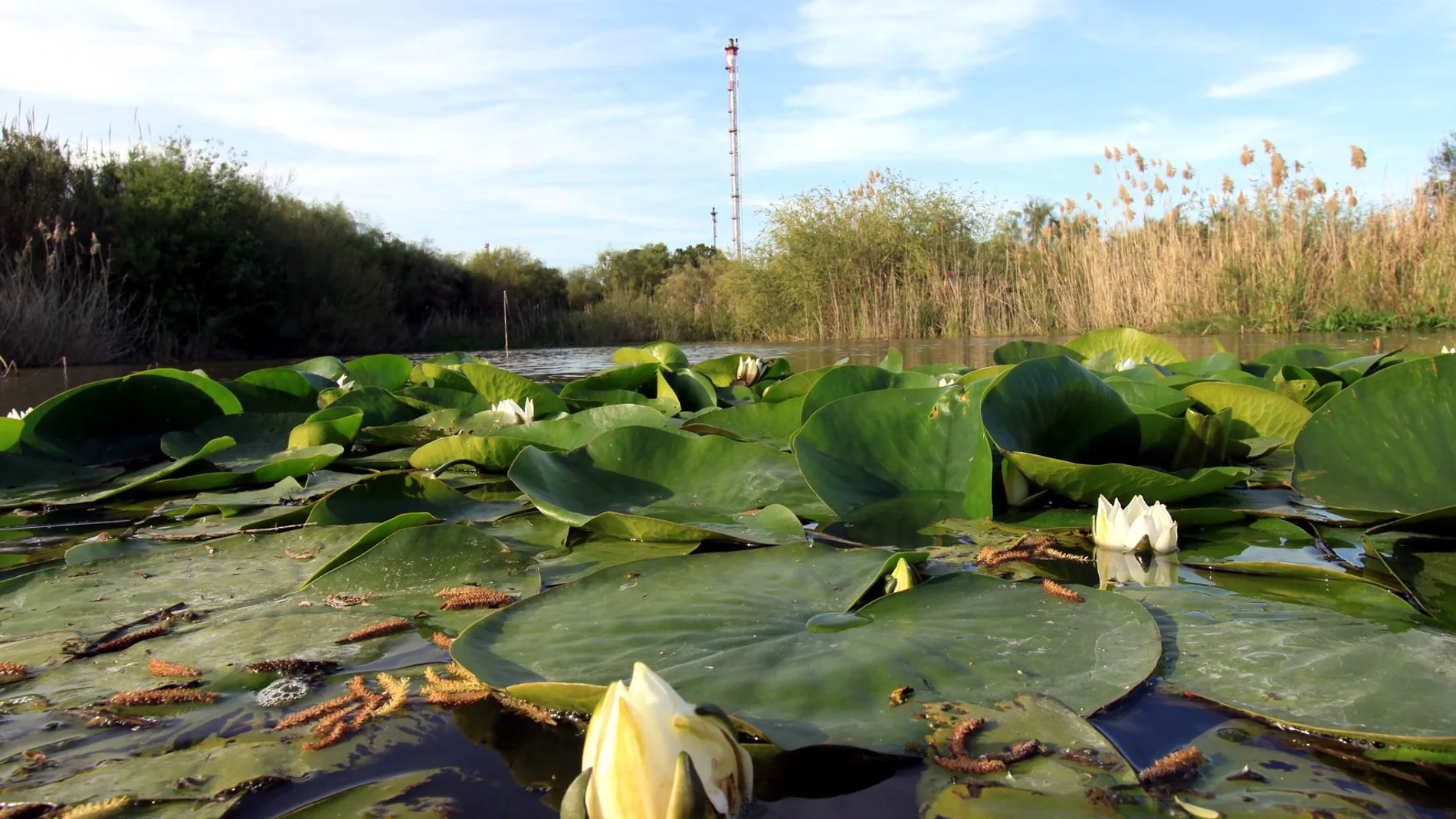
“We find ourselves with a very degraded system,” recalls the biologist Javier Camacho. In the early 2000s, intensive strawberry crops surrounded the First Lagoon of Palos (Palos de la Frontera, Huelva). Agricultural plastics were accumulating and natural vegetation had almost disappeared. Today, the image is different.
After almost 25 years of continuous intervention promoted by the Moeve Foundation, in collaboration with the Junta de Andalucía, this enclave has become a biodiversity sanctuary where more than 80 threatened species They have found refuge. A natural space that captures carbon, stores fresh water and serves as a stopover for migratory birds, complementing ecosystems such as Doñana or the Odiel Marismas.
Camacho, who is also director of Environmental Treatments and Projects at TYPMA, knows every inch of the wetland. His consulting firm is in charge of maintaining the lagoon, from the construction of infrastructure to research and monitoring. «The project emerged in 2001“, he indicates, explaining that “what began as a compensatory measure for the installation of storage tanks outside the refinery became a comprehensive long-term restoration.”
The starting situation was critical. «Almost the entire perimeter of the lagoon was occupied by greenhouses», says the biologist. The presence of agricultural plastics, overgrazing and poaching painted a complicated scenario. The initial intervention focused on cleaning the environment and recovering ecosystem functions, negotiating with farmers to put in perimeter protection strips and eliminating dikes.
That first impulse was key to establishing a more ambitious restoration. “The vocation from the beginning was to apply a real ecological restoration, acting on the vegetation, hydrology and fauna, and then make the space available for public use,” he explains. Teresa Mañuecodirector of the Moeve Foundation. Over time, he adds, the lagoon has evolved “towards an active management model,” incorporating scientific research, control of invasive species and outreach programs.
Today it houses 401 speciesespecially vulnerable waterfowl, and has recovered 30 hectares of natural area. One of the biggest challenges has been, precisely, the management of invasive exotics. And it is not enough to protect the environment: problems can arise from within. «We detected that the black bassa freshwater perch of Norwegian origin, ate between 80% and 90% of the flocks of waterfowl,” says Camacho, describing this animal as “the enemy at home” that degrades the balance achieved.
The carp is another threat, since by removing the sediments from the bottom they prevent light from reaching the vegetation, causing the loss of biodiversity. To combat this, the management team has carried out controlled drying processes of the lagoon, reducing up to 99% invasive fish populationalthough it recognizes that its total eradication is almost impossible due to its high capacity to regenerate.
Almost two million investment
This project is not only limited to environmental engineering. The total investment by the Moeve Foundation – which promotes these actions in its areas of influence – exceeds 1.8 million euros and has made it possible to preserve more than 52.85 hectares of wet spots such as the Marismas del Odiel Natural Area, also in Huelva, or the Madrevieja Environmental Station, in Cádiz. In the latter, 67 specimens of owls have been released and work is being done on the recovery of the turtle. In total, in Spain, the protection of 715 native species of fauna and flora.
Environmental education is the other great pillar of the program. During the last year, these spaces received more than 7,600 visits from researchersinstitutions and educational centers. Nearly 4,800 male and female students participated in awareness programs. Camacho highlights “the creation of vegetation screens”, which allow the visitor to immerse themselves in nature without perceiving the nearby industrial environment.
The Foundation’s work now looks toward the entire basin. «The wetland is not alone; “It receives water from its entire basin, which is occupied by intensive crops,” warns Camacho. Excess fertilizers and erosion of agricultural land can cause water eutrophication, a process that kills life at the bottom of the lagoon due to lack of oxygen. Hence the current strategy involves “governance”: reach agreements with local administrations and farmers to improve the quality of the water that reaches the ecosystem.
This model, considered a “pilot project”, can be replicated in other wetlands with similar problems, such as Laguna del Portil or even areas of Doñana. In 2025, Fundación Moeve signed agreements to reinforce its presence in high-value ecosystems in Andalusia and the Canary Islands, which include, for example, the creation of a new artificial wetland in Fasnia (Tenerife) or the restoration of La Mejorada in the Brazo del Este Natural Park (Seville). Thus, Laguna Primera de Palos has become an example that, with the union of science and investment, the heartbeat of the marshes can continue to live for future generations.