
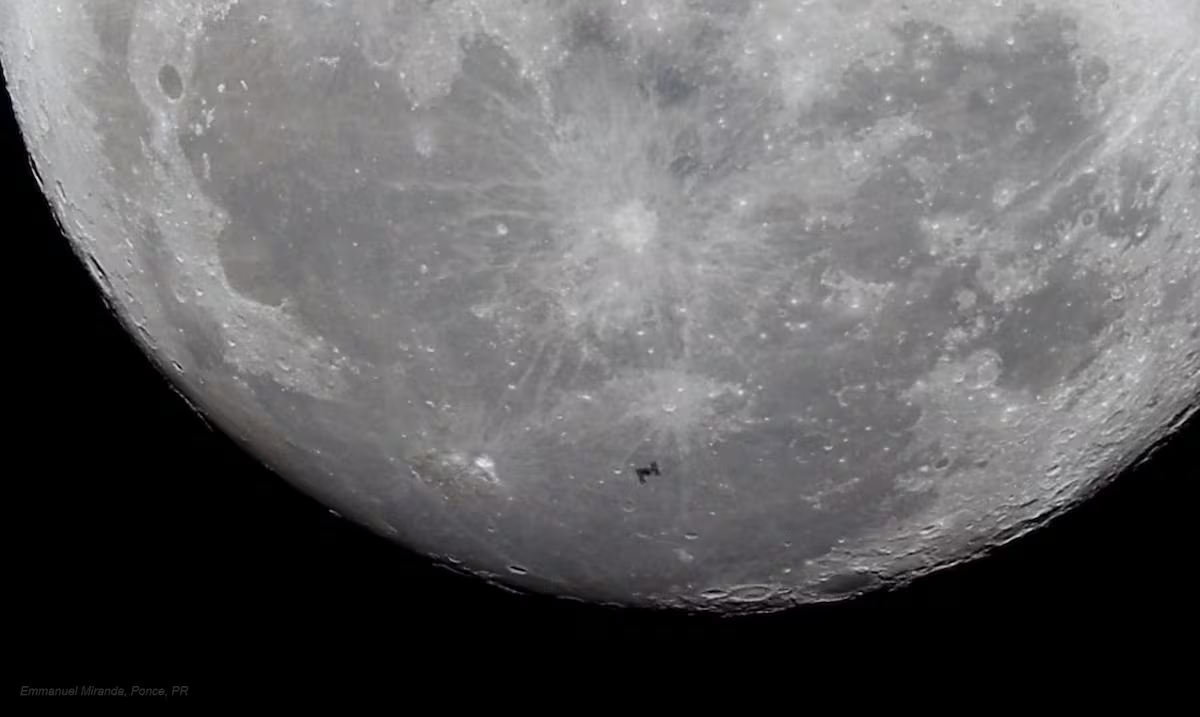
The countdown has begun and, at a time when the eyes of space and astronomy fans are focused on the long-awaited launch of Artemis II —a mission that will mark the return of human beings to lunar orbit in more than half a century—, an event captured from Puerto Rico recalled the proximity of this new era of exploration.
At around 7:56 pm and 8:00 pm on Tuesday, Emmanuel Miranda, of the Caribbean Astronomy Society (SAC), pointed his telescope towards the Moon and managed to capture the International Space Station (ISS) just as it passed over the island in front of the natural satellite.
The educational entity explained that, Although the phenomenon was visible from all of Puerto Rico, in municipalities located in a strip that includes Isabela, Utuado and sectors to the northeast of Ponce, the “transit” effect could be seen.in which the station appears to move directly in front of the Moon.
Currently, seven people inhabit the ISS, where they carry out various scientific experiments. The crew includes astronauts from the United States, Japan and Russia.
Waiting for the historic Artemis II
The sighting occurs at a key moment for space exploration, when four astronauts prepare this Wednesday to take off at 6:24 p.m. from the Kennedy Space Center National Aeronautics and Space Administration (NASA), in Floridaas part of the mission Artemis II.
The space agency is accelerating final preparations for this historic operation, which will return humanity to the orbit of the Moon for the first time since the Apollo 17 mission in 1972.
The crew is made up of NASA astronauts Reid Wiseman, Victor Glover and Christina Kochnext to Jeremy Hansenfrom the Canadian Space Agency (CSA), who will travel aboard the Orion spacecraft.
1 / 15 | Meet the crew of NASA’s Artemis II mission. One day (April 1, 2026) before the scheduled launch of the Artemis II mission, the National Aeronautics and Space Administration (NASA) finalized planning for its first manned mission to the Moon since 1972. – EFE Agency
During the mission, Orion will perform several maneuvers to raise its Earth orbit before placing itself on a free return trajectory around the Moon, allowing Earth’s gravity to guide the spacecraft back after its lunar flyby.
The trip is expected to last approximately 10 days, including a return trip of about four days. If completed as planned, Artemis II would become the manned mission that has traveled furthest from Earth, surpassing the more than 400,000 kilometers reached during Apollo 13.
In addition, its astronauts will be able to observe the far side of the Moon, an experience that was only achieved for the first time on the Apollo 8 mission in 1968. A year later, in 1969, NASA managed to get Neil Armstrong and Buzz Aldrin, from the Apollo 11 mission, to walk on the lunar surface.
The mission will also mark a milestone in the history of space exploration by including, for the first time on a lunar journey, a woman, a black person and a Canadian astronaut.
Artemis II is the second mission of the Artemis program, following the unmanned flight in 2022. It is part of a NASA effort to establish a sustained presence on the Moon and advance toward future deep space missions.
After Artemis II, the Orion spacecraft will return to the Moon with a crew as part of the program’s subsequent missions. In that plan, Artemis III—scheduled for 2026—would remain closer to Earth, at a stage comparable to the Apollo 9 mission in 1969, while NASA continues to refine the elements necessary for a lunar landing.
Later, Artemis IV plans to mark the return of astronauts to the lunar surface by 2028in an effort to emulate and expand the achievements of the Apollo program and establish a more sustained human presence on the natural satellite.
The missions occur amid increasing international competition, particularly with Chinawhich has set the goal of sending astronauts to the Moon before 2030.