
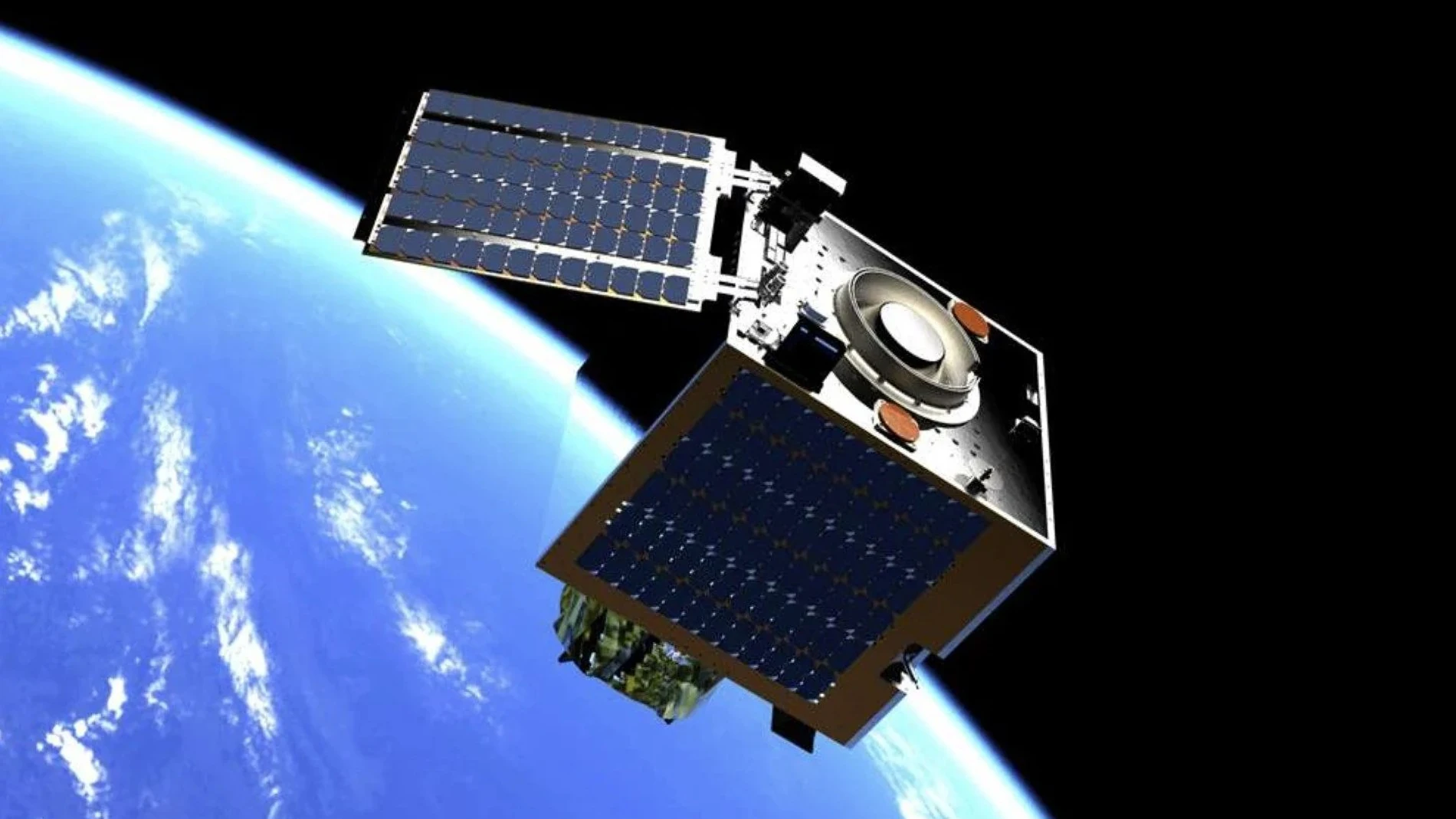
The London company SatVu is about to launch its new satellite, able to see through walls and detect detailed thermal signatures. HotSat-2which will travel to space this Sunday, will be able to provide data on human activity even when people are hidden behind ceilings and walls.
Some British media suggest that the satellite could look ‘inside’ Iranian nuclear facilities to assess whether they are still operational. But, outside the military or intelligence sphere, that same capability opens up an obvious debate about privacy and surveillance.
‘MWIR thermal images detect heat from operating assets, such as occupied buildings, reactors or hot water dischargeseven in the dark,’ explains the company on its website about satellite technology.
The launch of HotSat-2 will take place aboard a rocket Falcon 9 from the Vandenberg Space Force Basein California, and as part of the latest shared mission of SpaceX, Transporter-16.
London-based SatVu provides high resolution thermal images from space. According to The Telegraph, the company’s satellites use advanced infrared cameras to capture images 30 times more detailed than those from the satellite Landsat of the POT. The media points out that satellite images play a key role in the conflict between USA and Iran. SatVu already detected in 2023, with its satellite HotSat-1an increase in activity in the Nuclear Scientific Research Center from Yongbyon, in North Korea.
The British company, which is backed by 30 million pounds (about 34.7 million euros) financed by the NATOaspires to operate in the future a constellation made up of eight satelliteswith HotSat-3 already in development. This would allow you position yourself over any point on the planet in a maximum of two hours. SatVu already has agreements with the United States Government, Japan and several European countries, but not with the United Kingdom.
This is the HotSat-2 satellite
HotSat-2 is a thermal observation satellite that will operate in low orbit, about 500 kilometers altitudeand weighs about 130 kilosaccording to the SatVu technical sheet. It is not a large telecommunications satellite, but a platform much more compactdesigned to capture high-resolution thermal data from space. The expected useful life is five years.
Use a sensor MWIRacronym for Mid-wave infrared. It does not take images like a conventional camera, but detects thermal radiation, i.e. heat differences. This allows you to identify which areas, buildings or infrastructures are most thermally active and do so both day and night. Thus, it is able to measure what is working, what is stopped, and how those patterns change over time. In each image, you can encompass an area of 3.5 by 4.5 kilometers.
Intelligence based on thermal data
Satellites like HotSat-2 can provide valuable information to allies in the context of the conflict in Iran. They can also be used to better measure the extent of damage to key infrastructure in the Middle East and, thereby, better anticipate its impact on the energy market.
In an interview with The Telegraph, Anthony BakerCEO and co-founder of SatVu, says: ‘If you see a big explosion in Ras Laffan in Qatar, you don’t know how much has been engulfed in flames. Our images allow you to know with much more certainty which part has been hit and is out of service.‘. According to Baker, the SatVu images have enough detail to detect which pumps of a nuclear reactor are in operation and which are not.
‘By returning to orbit, we are restoring a critical capability for our partners and customers. High-resolution thermal data is no longer simply an added value; are a fundamental requirement to complete geospatial intelligence assessments‘, says the CEO in a statement.
HotSat-2 is not the first satellite that SatVu has put into orbit. HotSat-1also with high resolution thermal observation capacity, It operated between June and December 2023, before suffering an anomaly that interrupted the mission.