
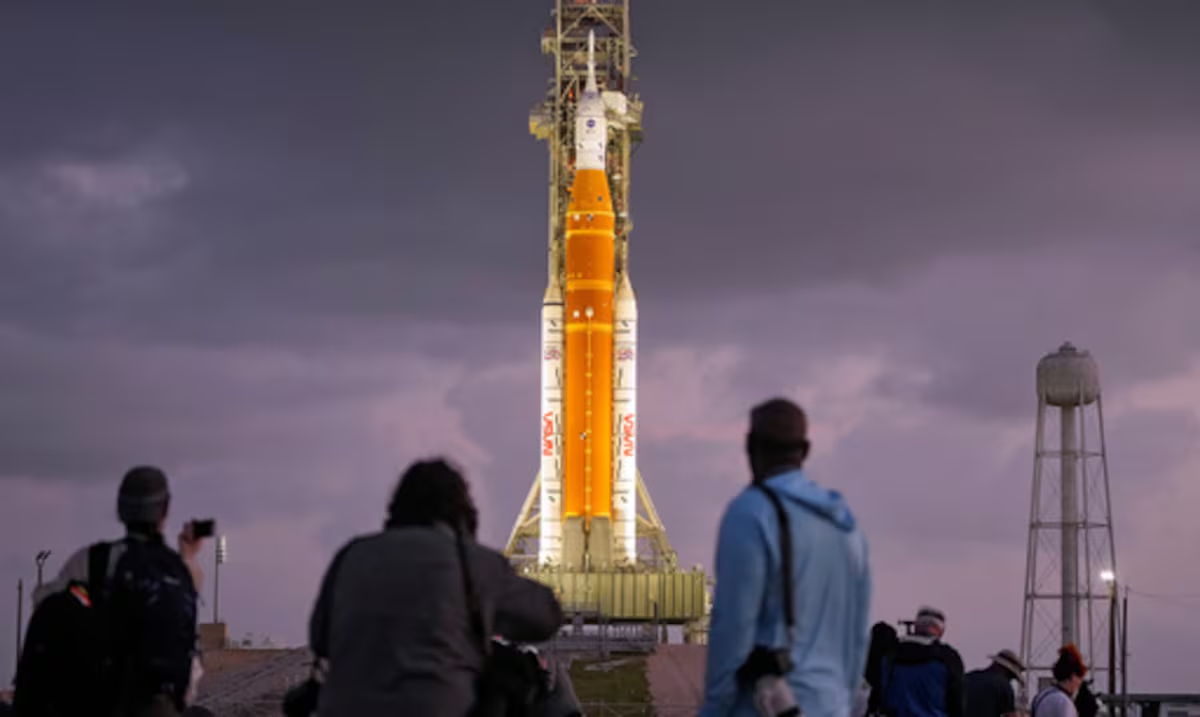
Cape Canaveral – It is humanity’s first flight to the Moon since 1972.
NASA’s Artemis II mission, a nod to Apollo, has already sent four astronauts on a lunar flyby. They will launch several thousand kilometers beyond the Moon, make a U-turn and return directly. No circling the Moon, no stopping for a moonwalk, just a quick round trip that will take less than 10 days.
NASA promises more boot prints in the gray lunar dust, but not before a couple of practice missions. The newly launched test flight of Artemis astronauts Reid Wiseman, Victor Glover, Christina Koch and Jeremy Hansen is the first step to settling on the Moon this time.
The 32-story-tall Space Launch System rocket lifted off Wednesday night, with a two-hour launch window beginning at 6:24 p.m. at the Kennedy Space Center in Florida.
Here is a summary of the Artemis II mission:
Artemis astronauts are a diverse and international crew
The Moon is about to welcome its first woman, first person of color and first non-American.
Koch already holds the record for the longest space flight by a woman. During her 328-day mission to the International Space Station in 2019 and 2020, she participated in the first all-female spacewalk.
Glover, a Navy test pilot, was the first Black astronaut to live and work aboard the space station in 2020 and 2021. He was also one of the first astronauts to take off with SpaceX.
1/12 | Just hours away: this is how the Artemis II astronauts arrived at the launch pad. The crew arrived at the Launch Complex four hours before the estimated takeoff after completing the walk at the Kennedy Space Center in Cape Canaveral, which “every NASA astronaut has done since the Apollo 7 mission in 1968.” -Chris O’Meara
Hansen, a former Canadian Space Agency fighter pilot, is the only space rookie. Its commander is Wiseman, a retired Navy captain who lived aboard the space station in 2014 and later led NASA’s astronaut corps. Their ages range between 47 and 50 years.
The Space Launch System is more powerful than the Saturn V rocket
NASA’s new Space Launch System rocket measures 98 meters, shorter than the Saturn V rocket of the Apollo program but more powerful at takeoff thanks to a pair of coupled boosters. On top of the rocket is the Orion capsule that transports the astronauts.
Made with salvaged space shuttle engines and other parts, the SLS uses the same fuel – liquid hydrogen – as the shuttles. Hydrogen leaks repeatedly grounded the shuttles, as well as the first test of the SLS rocket without astronauts on board in 2022. More than three years later, Artemis II suffered the same hydrogen leaks during a fueling test in February, missing the first launch window. Recurrence of helium flow problems delayed the mission until April.
1 / 15 | Meet the crew of NASA’s Artemis II mission. One day (April 1, 2026) before the scheduled launch of the Artemis II mission, the National Aeronautics and Space Administration (NASA) finalized planning for its first manned mission to the Moon since 1972. – EFE Agency
How will Artemis II fly around the Moon?
After takeoff, the astronauts will spend the first 25 hours circling the Earth in a high, inclined orbit. They will use the separated upper stage as a target, steering their Orion capsule around it as docking practice for future launches to the Moon. Instead of fancy rangefinders, they’ll rely on their eyes to judge distance, venturing no closer than 33 feet (10 meters) from the stage.
“Sometimes simple is best,” Wiseman said.
If all goes as planned, Orion’s main engine will launch the crew to the Moon, about 244,000 miles (393,000 kilometers) away. This free return trajectory, made famous by Apollo 13, relies on the gravity of the Moon and Earth, minimizing the need for fuel.
On the sixth day of flight, Orion will reach its farthest point from Earth as it sails 5,000 miles (8,000 kilometers) past the Moon. This will surpass the distance record of Apollo 13, making the Artemis astronauts the most remote travelers. After leaving the Moon, the crew will head directly home with a splashdown on the tenth day of flight, nine days, one hour and 46 minutes after liftoff.
1/11 | This is what it looked like when Artemis I began with the launch of the new lunar rocket. Almost three months after the first launch attempt, the powerful lunar rocket of the Artemis I mission took off towards the orbit of the Moon. – The Associated Press
What to expect during the Artemis flyby
The Artemis II crew may see never-before-seen regions of the far side of the Moon, which will appear the size of a basketball at arm’s length during the closest part of the roughly six-hour flyby. They have been poring over maps and satellite images of the far side of the Moon and anticipate a photography frenzy. His lunar mentor is NASA geologist Kelsey Young, who will follow the flyby from Mission Control in Houston.
“The Moon is like a unifying element,” he said. “What we are doing with this mission is going to bring it a little closer to everyone.”
In addition to professional cameras, they will carry the latest smartphones. The new administrator of NASA, Jared Isaacman, has added smartphones to the mission to take “inspiring” photos.
While NASA and private companies have focused over the years on reaching the far side of the Moon – the one that constantly faces Earth – only China has placed landers on the far side. This makes the astronauts’ observations of the far side even more valuable to NASA.
Artemis astronauts will return to Earth
Like Apollo, the Artemis mission ends with a splashdown in the Pacific.
All eyes will be on Orion’s heat shield as the capsule plunges into the atmosphere. It’s the part of the spacecraft that took the biggest beating during the 2022 test flight, with charred chunks torn off. The heat shield is being modified for future capsules, but remains the original Artemis II design.
NASA is limiting heat exposure during reentry by shortening the capsule’s atmospheric descent. Navy recovery ships will be parked off the coast of San Diego as Orion parachutes into the ocean.
This story was translated from English to Spanish with an artificial intelligence tool and was reviewed by an editor before publication.