

Discrimination based on age, especially of older or elderly people. This is how the Royal Spanish Academy defines the term “ageism”a word that since 2022 has been part of the Dictionary of the Spanish language. However, contrary to what one may think, the existence of this word goes back much further. It was in 1969 when Robert N. Butler –American doctor, gerontologist, psychiatrist and author– coined this expression to describe the prejudices, stereotypes and discrimination that people suffer due to their ageequating it with racism or sexism, and denouncing that this new way of discriminating seemed to be very normalized in society.
Butler ended up being the first director of the National Institute on Agingand in view of what is currently happening, it can be said that he knew how to read very well a reality that, decades later, is still fully valid: despite the advances in rights and equality, we continue to live in a society that continues to reproduce attitudes, discourses and practices that They marginalize people for the simple fact of their birthday.
For several years now, the term “ageism” has frequently appeared accompanied by the adjective “labor” with the aim of naming a reality that is increasingly evident in the professional field: As age advances, the difficulties in accessing employment multiply, stay there or progress within a company. However, this phenomenon is not unidirectional. On the one hand, the older people They are often discarded under stereotypes that consider them less adaptable or productive; on the other, the young people They face barriers derived from their supposed lack of experience. Thus, occupational ageism reveals how prejudices associated with age continue to condition, at both extremes, opportunities within the labor market.
At the end of last year, the Organization for Economic Cooperation and Development (OECD) developed a report on Spain that focused on the aging of the population; the impact this has on pensions; and the need to stop “early retirements.” However, this document recognized the difficulty that senior profiles present in staying within the market, and the existence of “age discrimination” was mentioned and “stereotypes” that go against people with experience and training to carry out professional work. The text also pointed out that in the Peninsula, older workers They leave the labor market “relatively soon”and face “much longer” periods of unemployment. But why does this happen?
The OECD’s explanation goes through the financial crisis that began in 2008a time when many seniors left the market and did not join later: “The experience left a legacy of erosion of skills, discouragement and limited opportunities for reintegration into the workforce, especially for people with a lower educational level and who lost their jobs in highly affected sectors, such as construction.” But the problem also affects workers with a higher educational level.
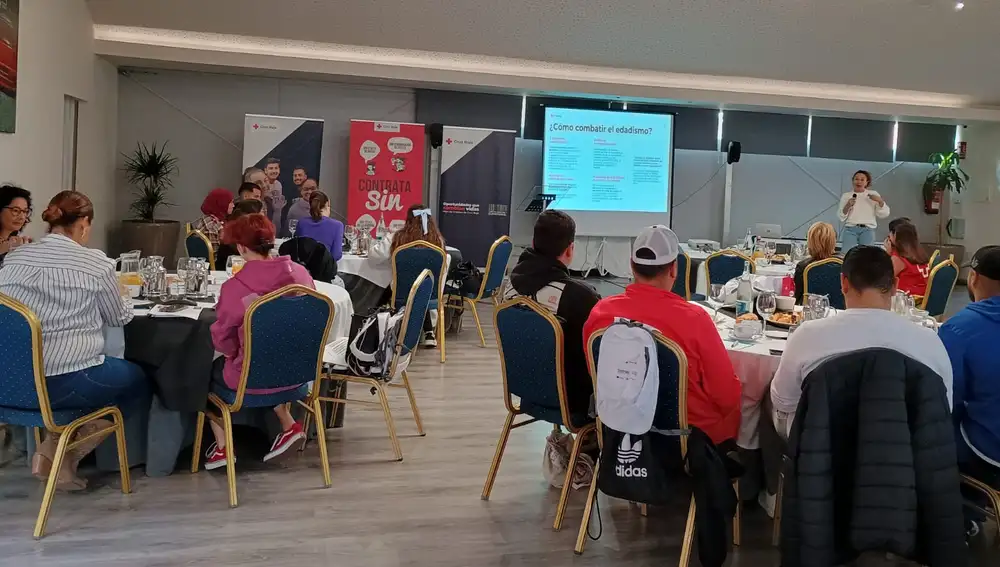
From Red Cross have wanted to put this problem in the spotlight and have prepared a report and a survey under the title «Ageism and Me»in order to have more information about “how the date of birth has become an insurmountable barrier for talent, affecting both the dignity of older people and the opportunities of younger people,” the organization explains. The results obtained are conclusive and “draw a scenario of urgency.”
Of the 900 participants of the Red Cross Employment Plans, 44% claim to have suffered discrimination due to age, a situation that occurs mostly – in 84% of cases – during the job search processes, preventing access to the market before even being able to demonstrate their professional worth. In the case of people over 45 years of age, 58% report having suffered ageism.
Marta Albuerneresponsible for Employment Programs of this NGO, says in an interview for LA RAZÓN that “it is empirically proven that people who are over 45 years old “They have to apply for twice as many job offers to be able to get to an interview.”which exemplifies that discrimination begins in the selection processes. According to Albuerne’s experience, many people come to the Red Cross thinking that what is happening to them is something individual, “something that happens to you as an individual, that you do not get an offer or they do not call you because the problem is you.” However, when they know and become familiar with the term “ageism”, they discover that there is also discrimination that is affecting them, «which is much more structural and that, somehow, We are all susceptible to suffering, because we are all going to have a birthday.”
This barrier is also clearly reflected in the statistics: according to data from Eurostatin Spain more than half of unemployed people over 50 years are in a situation of long-term unemployment, which shows the real difficulties in re-entering the labor market from that age onwards. If we add to this context the increase in life expectancy and the consequent prolongation of working life, it becomes even more evident that the presence of older people in the market is not only increasingly significant, but also most essential.
Marta Albuerne considers that There has to be a reflection on the part of companies“because they are losing talent.” To talk about a person who is 45 years old or older is to talk about someone who “has gone through several profound and radical technological changes, several crises, and probably many experiences that have made him learn and face life to continue moving forward.”
One of the negative stereotypes associated with age is lack of adaptation and difficulties with learning, something that Albuerne takes as irony: «What do you mean you’re not going to learn? If you’ve been doing it your whole life! In this sense, it also claims the need to promote inclusion and continuous training in new technologies for all employees of a company, regardless of their age.
From the Red Cross Employment Programs they work directly with people, and Albuerne emphasizes that it is very important, on a psychological level, to be there “so that they do not decline and “they can access a right as basic as employment”. According to him, on numerous occasions, companies’ speeches penetrate applicants and they end up internalizing what they hear and believing that, effectively, they will no longer be able to learn or re-enter the wheel of the labor market.
Patricia She is 52 years old, Argentine, a teacher and arrived in Spain in 2024 with her family. He has participated in the Red Cross Employment Programs, has found work in a supermarket and has suffered ageism. In a conversation with LA RAZÓN, he says that he went to an interview and “They secretly told me that they were looking for someone more jovial”. “And I am very jovial, I swear, I am 52 years old and have four children, the youngest is 10 years old and the oldest is 26. I have to live up to both of them,” he adds. Her experience has not been something isolated, and throughout these years in Spain she has seen how other colleagues who did training with her “went to many interviews to do internships and, if they were older, they were never selected, “They always caught the youngest ones.”. This teacher realized that the rejections were not due to qualities or aptitudes, because the questions they were asked went well, the interview went well, “but it was clearly age,” she says.
After a couple of experiences similar to this one, Patricia did not hesitate to remedy it. And what was in his hand? Change the date of birth on the resume. «It’s horrible, but I did it. There was no other way to at least get to an interview. And I had to work. So I looked for all possible ways. You have to be skillful and emotionally strong, because it affects you,” he acknowledges. It affected her, especially the first few times, “because you know that you are worth it, that you are useful, that you can do that job, and they don’t give you even half a chance”. But later he learned that “it’s their loss, and that age should be many things and not a limit, because the life experience you have is not expressed in a resume and can be useful.” The offers you applied for after changing your year of birth They ended up in interviews.
Take measures in favor of intergenerational coexistence and addressing the situation in a comprehensive manner, including institutions and companies, seems necessary to create a fairer labor market in which age stops being an obstacle and becomes a value.