
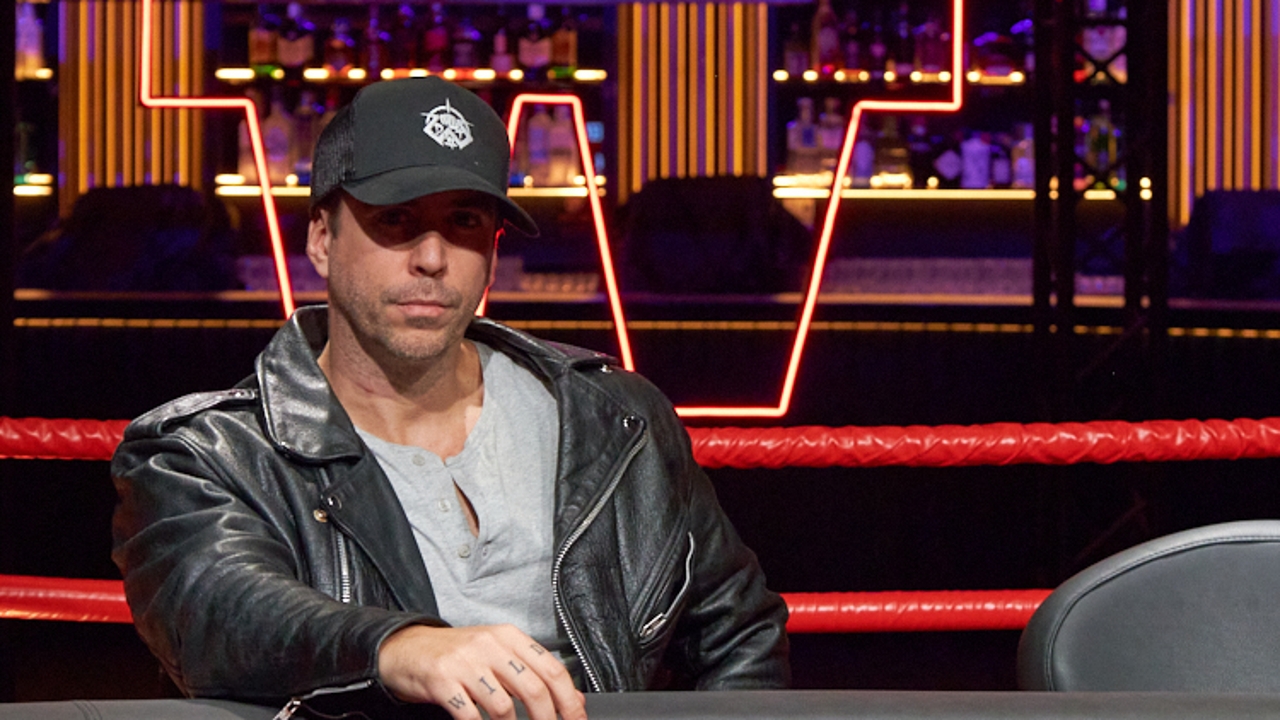
At a poker table and far from the usual studio format, Jordi Wild (Barcelona, 1984) talks with LA RAZÓN about his professional evolution, the success of his podcast – one of the most listened to in Spanish – and the challenges of staying on the front line in an increasingly polarized digital environment. The interview, carried out within the framework of a timba organized by Winamax, allows the content creator to reflect on public exposure, the management of criticism and his constant creative reinvention.
Question (P.): For those who don’t know him, who is Jordi Wild today and how would you define his professional career?
Answer (R.): I am a content creator. I work in the digital environment and currently have a podcast that,Within this format in Spanish, it is the one that is working best worldwide. It is a space in which I invite very varied profiles: from Internet people to scientists, social figures or athletes.
In addition, I continue with my YouTube channel, El Rincón de Giorgio, where I have been making diverse content for many years. In recent times the separation between digital and conventional has been diluting; Before it was very marked and now there are more and more synergies. My approach has always been to make content that doesn’t fit the typical Internet stereotype. In fact, a significant part of the podcast’s audience is not the usual network audience.
Q. When did you feel that YouTube stopped being a hobby and became a profession?
A. I started with the idea that, at the very least, it could give me a decent salary. After a year or a year and a half, the project exploded and I understood that I had to dedicate myself completely to it, that it could be my way of life. Over time it grew more and more until it became something much bigger.
Q. After hundreds of interviews, what have you learned from listening to such different profiles?
A. Above all, humility. You realize that, Even if you think you know a topic, there will always be someone who knows much more than you. This forces you to listen better and respect other points of view.
You also learn to converse: to listen, to know when to intervene. I have learned from popular science to geopolitics, specialized sports or art. I only do a podcast when the topic really interests me.; I never do it to do something outside of my control.
Q. With millions of listeners, the exhibition also brings criticism. How do you manage the current “hate” and polarization?
A. I have been doing this for almost 15 years and when you become a big figure you have two options: Either you become iron and learn to live with it, or you sink from time to time.
We live in a very polarized time and Networks amplify everything, the good and the bad. The best thing you can do is relativize. When a lot of criticism comes I know that, in two weeks, there will be another controversy and no one will remember. And the same thing happens with praise: today everything is going well, but tomorrow it can change.
Most people who comment on the Internet don’t really know you.; You are just another entertainment. Some entertain themselves by criticizing. It doesn’t seem right to me, but it doesn’t affect me either.
Q. Do you listen to criticism when you are already established?
A. I learn from any criticism, even anonymous. Someone may tell you that you interrupt too much and make you think. But when you are already consolidated, Obsessing over criticism – even constructive criticism – can be more negative than positive.
At first you have to be a sponge. Later, Focusing too much on what others say can make you question your own core. Today, I rarely listen to criticism because I think it would bring me more insecurity than improvement.
Q. Has any guest radically changed your mind?
A. Yes, the clearest case was an expert on the life of Michael Jackson. I had an image very marked by controversies. He explained each of them in detail and made me change my mind. Today I would defend Michael Jackson.
It is not usual for a guest to change you from zero to one hundred, but in this case it was like that.
Q. Do you fear becoming stagnant creatively?
R.If you look at my career, I have evolved a lot. I started with a variety channel with humor, playing dozens of topics. Then I reinvented myself with the podcast, something completely new for me, and that marked a before and after, especially with the audience outside the Internet.
Then I launched Dogfight Wild Tournament, which has nothing to do with the above. AND Now I’m writing a novel, which is my big project.. It’s what I’m most excited about in a long time.
Q. This year the Dogfight moves to Madrid. What can we expect?
A.Yes, this year we are going to Madrid, at the end of May, in a mythical venue in the city. It’s going to be the best edition so far.
Last year there were things that worked very well and others that didn’t. When you do something experimental it can turn out spectacular or it can fail. This year we are going to correct those mistakes.
Q. And since we are in a game, how do you define playing poker?
A.I am a friends player. I like to be with my colleagues, stay up late and spend hours playing in a relaxed atmosphere.
It depends on the day: I can be very conservative, waiting for the right hand, or have a more daring day and bluff. I alternate until I have a good hand and then I go all out.