
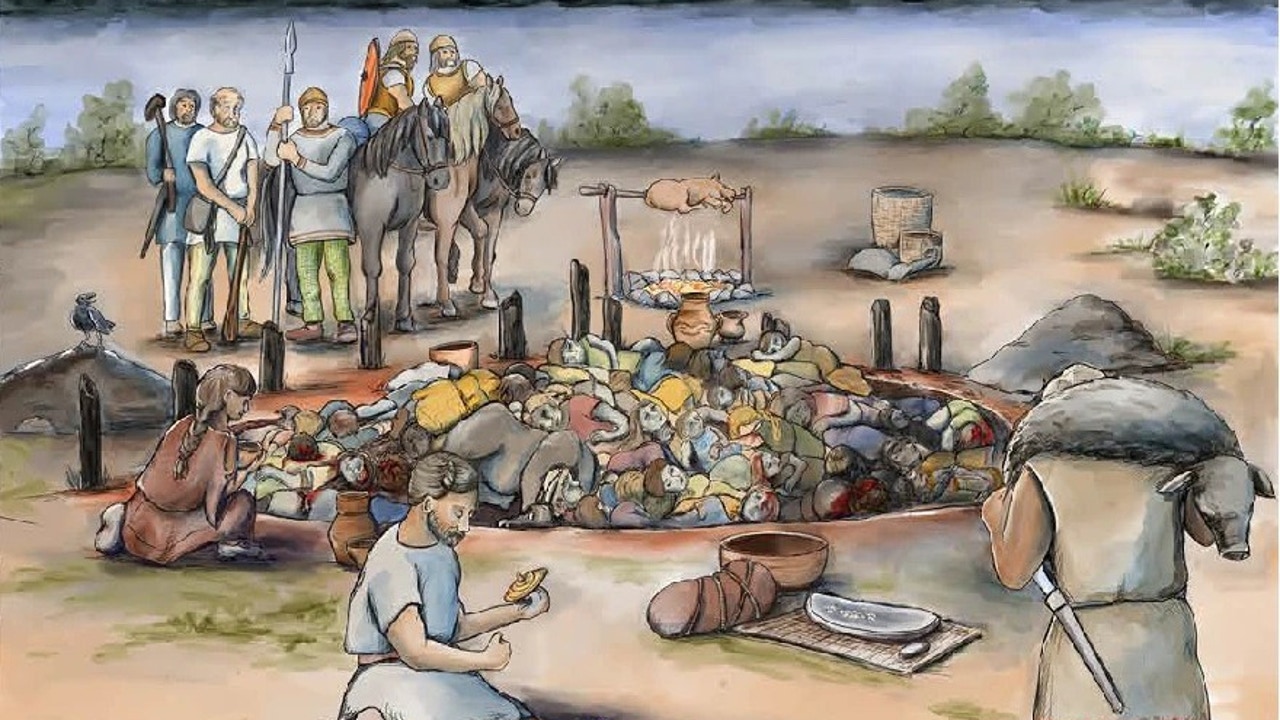
The common grave with the bodies of 74 women and children and 3 mendated from ago 2,800 yearsis not a new discovery. It was located at the beginning of the decade of the 70 at the archaeological site of Gomolavanext to the river Savasouth of Novi Sadin Serbia. So, archaeologists thought that the burial, in which more than half of the people were under 12 years old, was the result of an epidemic. The truth, however, is much more terrible.
New research published this Monday in Nature Human Behavior reveals signs of trauma in dozens of skeletons, along with evidence that the buried individuals, for the most part, were not genetically related and had grown up in very distant places, data that points to an intentional massacre. The authors maintain that selecting women and children to kill and bury in a visible location may have been a public assertion of power directed against rival groups.
The team began reexamining the bones, currently stored in the Vojvodina Museumin Novi Sad, seven years ago as part of a study on the prehistory of the region. Barry Molloyarchaeologist at University College Dublin and co-author of the new paper, explains that initially ‘We were expecting a village community that died en masse when a disease arrived’.
Massacring women and children, a strange choice in the early Iron Age
That’s why, Linda Fibigera bioarchaeologist at the University of Edinburgh, was surprised to find that one in five individuals had bone trauma. Mainly fractured skulls, but also arrow wounds and cuts that left marks on the bones. Since many fatal injuries leave no marks on the skeleton, Fibiger concluded that probably all the women and children in the pit were executed.
That raised a new mystery. Whether they were friends or enemies, in the times of the 9th century BC women and children were especially valuable resourcessince they represented the future of the communities, at best, and, at worst, a useful reserve of forced labor. Killing them was therefore a strange choice.
Genetic analysis revealed that, with the exception of a mother and her two young daughters, none of the individuals in the grave were biologically related, something that would be expected if a village or clan had been attacked and exterminated. Chemical isotopes of their teeth showed that They did not come from the Gomolava area and grew up eating different types of food.
‘These people had different childhood origins and different diets. We do not know if they were living together at the time of the massacre, but we believe they were part of a larger regional population‘, explains Look at Iraeta Orbegozoa geneticist at the University of Lausanne and co-author of the article.
Thus, more than the result of the attack on a single village, ‘it’s a group of people from different villages, all murdered in the same place, at the same time’says Molloy. The burial coincides with a period of instability in the Los Basin. Carpathianswhen different groups progressed with livestock and agriculture and began to build walled or closed settlements; Gomolava and nearby Sava then represented a border. ‘It seems like a source of tension between different ways of taking advantage of the territory’Molloy says.
A ritual burial in a mass grave
The team’s main hypothesis is that People fleeing conflicts elsewhere in the region were intercepted in Gomolava and killed by a rival group. However, Molloy believes that it was not a simple execution and that the massacre could have had an ideological or symbolic meaning.
The grave is located on top of a mound created by remains of previous, much older settlements, which stands out in an otherwise flat landscape. The dead were carefully placed in a shallow circular holebarely 3 meters in diameter. Cow and sheep bones suggest that the burial was accompanied by a food offering or an animal sacrifice. And among the remains were found personal ornaments (such as fibulas, hair rings, bracelets and rings), indicating that the bodies were not looted.
The victims were selected and their bodies arranged on the mound in a manner similar to how a trove of weapons or other valuable objects might be displayed. in order to demonstrate wealth and power. It could have been a message intended for intimidate potential rivals in a time of social unrest. ‘They try to show that they have the power to get rid of things that would be valuable to keep’says Molloy.
The reason that the victims were women and children is, according to Fibiger, because they attacked the roots of rival communities. ‘Women and children… have agency and a role in the transmission of traditions. Children are the future of a society and all that is taken away‘, he explains.