
Miami – NASA announced this Friday changes to its Artemis program, so it now plans two new missions to the Moon in 2028 instead of one, although the third expedition, Artemis III, Now it will no longer go to the natural satellite that year as expected and will only be a trip in low Earth orbit in 2027.
The modifications imply that the Artemis IV mission will seek to reach the Moon in early 2028 and the new Artemis V will also attempt to do so at the end of that year.revealed the administrator of the US space agency, Jared Isaacman, at a press conference at Cape Canaveral in Florida.
This means that Artemis III, which was intended as the return of humans to the lunar surface for the first time since 1972, is brought forward to 2027, but will now be an intermediate mission in low Earth orbit.
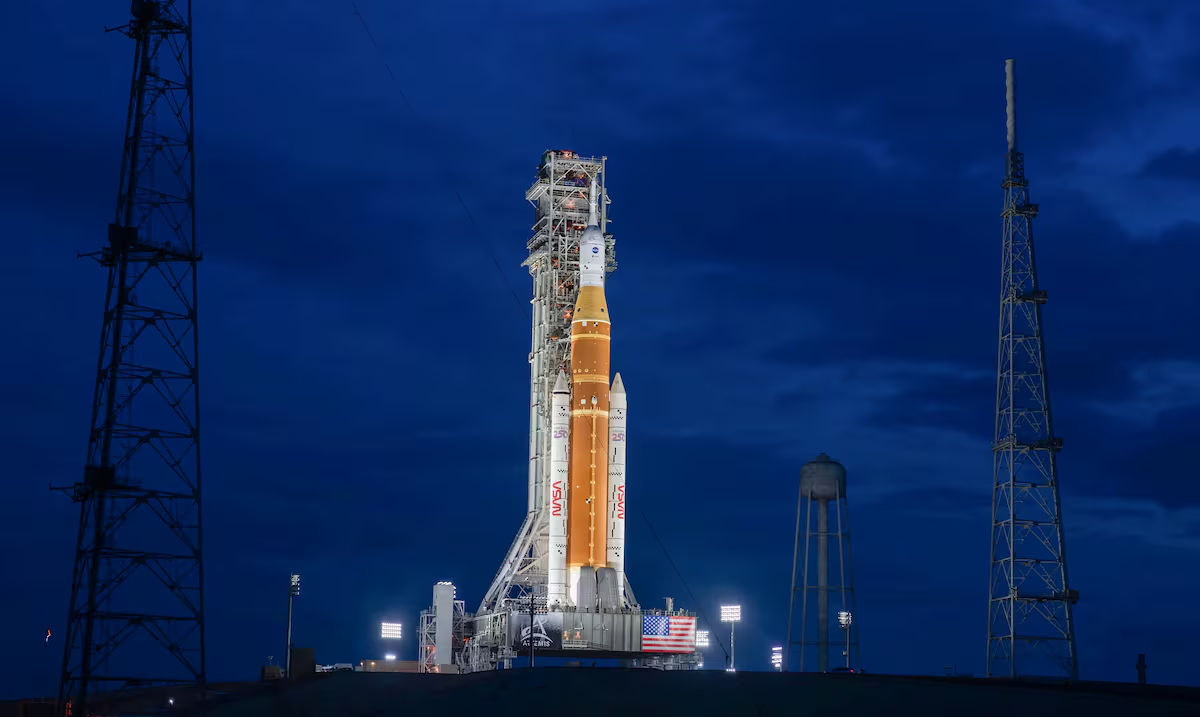
Meanwhile, NASA is trying to move forward with the launch of Artemis II, which has been postponed until at least April after being scheduled to send four astronauts to lunar orbit on March 6, after failures in the first cold test that prevented the launch in February.
The administrator of the US space agency explained that they seek to “increase the pace of launches” to “reduce the complexity” of the missions to “the greatest extent possible.”
The official also explained that the organization “needs to rebuild and strengthen the workforce at NASA” to achieve the new goals, which imply that launches occur every 10 months instead of every year.
“We need to start getting back to basics and moving in this direction, so we need to rebuild the civilian workforce and restore crucial capabilities again, that will directly contribute to NASA’s launch cadence,” he said.
Amit Kshatriya, NASA associate administrator, said the changes will allow the agency to maintain its mission schedule and create conditions for greater safety and lower costs.
“It is challenging, it is ambitious, but with this route correction we are on a more stable base, on a more realistic path to the milestones we have ahead,” he stated.
The changes are announced after delays due to technical failures faced by Artemis II, which will be the mission in charge of sending the first humans to lunar orbit in more than half a century, although it does not contemplate a lunar landing.
Despite modifications to subsequent missions, NASA is still working to “have the best possible chance” of launching Artemis II in early April, said Lori Glaze, the agency’s associate deputy administrator.