
A little more than six years have passed since the agreement was signed in Europe. Green Deal (end 2019)the roadmap intended to guide the community economy towards decarbonization. The renewable penetration objectives, climate regulations and mechanisms to support the different sectors to move towards net zero were decisively deployed until 2022. However, since the beginning of the war in ukraine The political discourse has changed. Concepts such as security of supply or Europe’s industrial weight have gained prominence in the language of the European Commission. Where before there was hardly any room for anything other than decarbonization, today there is talk of energy trilemma –security, sustainability and accessibility–, Nuclear energy has returned strongly to the future plans and combustion vehicles seem to have a longer life than expected beyond 2035, pressured by the massive arrival of low-priced Chinese electric cars.
The objective of achieving climate neutrality is formally maintained, although somewhat more decaffeinated. The rise of conservative political groups has introduced into the EU’s internal debate the questioning of some principles such as the definitive abandonment of fossil fuels. We saw it in Spain just a few days ago; Vox has just presented a Non-Law Proposal to repeal the Climate Change Law and the European Green Deal itself. These groups appeal to the possible economic and social consequences of an accelerated transition. For some analysts, the Green Deal has entered a phase of silent but profound political review. In fact, the second legislature of Ursula von der Leyen (2024-2029) has as one of its axes the reinforcement of European competitiveness, a priority indicated in the Draghi report, which anticipates a reduction in regulatory burdens and more flexible legislation, also in terms of sustainability.
However, advocates of Europe’s most ambitious line remain convinced that the green path is a scientific imperative and that the cost of inaction will far exceed any current investment. Joan Batalla, general director of the Foundation for Energy and Environmental Sustainability (Funseam), considers that “the European roadmap remains clear: the objective of climate neutrality in 2050 is maintained. However, until a few years ago, security of supply was taken for granted, an issue that the energy crisis resulting from the invasion of Ukraine has made central. This has led to strengthening policies aimed at energy sovereignty and autonomy, as reflected in the Clean Industrial Deal. We have a great opportunity thanks to renewable energies, green hydrogen and biomethane to increase energy production with indigenous resources,” he points out.
The European Union continues to advance in its objective of 42.5% of renewable energy in final consumption by 2030. In 2025, in fact, 30% of the electricity generated in the EU came from wind, solar and hydro, surpassing fossil fuels for the first time. In Spain, the progress is even more pronounced: wind and solar together contributed 42% of the electricity, with solar reaching a record of 22%. Furthermore, a joint report by the International Renewable Energy Agency (Irena) and the European Commission predicts that 70% of EU electricity renewable by 2030 and close to 90% by 2050Despite this, Brussels recognizes that the next decade will be decisive. The EU needs to massively electrify the economy, increase the weight of electricity in final consumption from 23% today to around 32% in 2034, strengthen energy efficiency and boost innovation. Batalla insists that, precisely the challenge It is not just electrifying, but decarbonizing the remaining 78% of final consumption. “A combination of solutions is key here: renewables, but also hydrogen, biomethane or renewable gases.”
Cecilia Foronda, director of the Action Mission for the Just Transition and energy expert at the Ecodes Foundation, points to China as an example. «The commitment to renewables and electric vehicles is growing because they have understood that a decarbonized economy reinforces their competitiveness, their energy sovereignty and the health of their population. The energy transition is the only real way to guarantee competitiveness and energy security in Europe. If we continue to decelerate, we will miss the boat compared to countries that have stepped on the accelerator,” explains the directive.
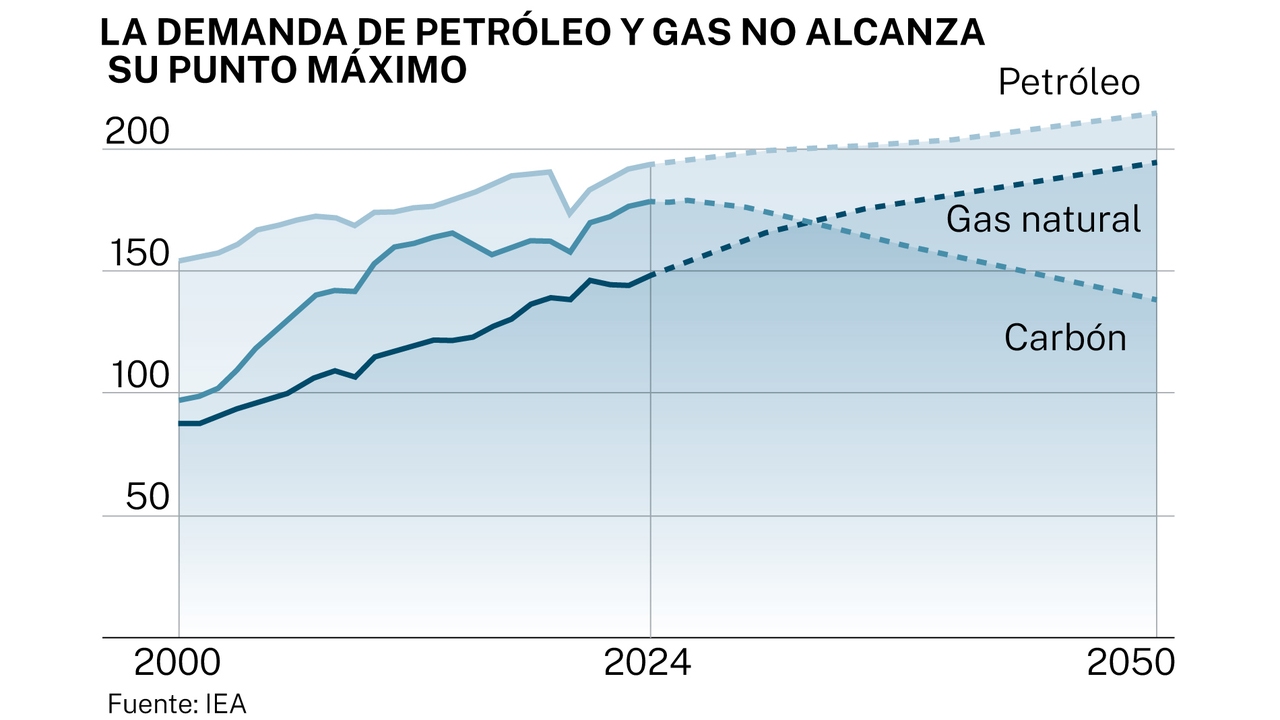
Although renewables are growing both in Europe and in the rest of the world, the truth is that the end of fossil fuels is still far away. Globally, oil consumption continues to increase, driven by Asia and emerging economies. According to OPEC, in 2026 106.5 million barrels per day will be reached, 1.38% more than in 2025. The International Energy Agency already speaks of the “Age of Electricity”, with an increase in electricity demand of 40-50% until 2035, driven by data centers, artificial intelligence and air conditioning. However, warns that three quarters of this additional demand will still be covered by gas, oil and coal (In Europe, Germany’s renunciation of nuclear power has led to an increase in coal burning). In 2025, global coal demand amounted to 8.85 billion tons, and it is not expected to begin to decline until 2030. Emerging economies like India will shape the dynamics of the energy market in the coming years, but will they weaken Europe’s energy policies even further?
Reindustrialize and decarbonize
In some European countries, The industry continues to represent 25% of GDP. The fear of losing industrial fabric, especially in sectors such as the automobile, has led the EU to soften key decisions, such as the calendar to prohibit the sale of combustion cars beyond 2035, or to launch initiatives such as the Clean Industrial Deal, signed in 2025, which seeks strengthen competitiveness without formally abandoning climate objectives. Here, the clash between defenders and detractors of the Green Deal is evident. For its critics, European regulation has ignored the laws of the market and penalized local production. For Foronda, on the other hand, “what we are seeing is a progressive delay in commitments and deadlines for fear of losing competitiveness against the United States or China.” And he warns: “China has seen an opportunity in the energy transition and has not stopped.”
The return of the atom
Nuclear energy has gained weight in the European debate as a tool to reduce dependence on imported gas and guarantee security of supply, an argument that has also permeated Spain after the blackout in April 2025. Between 2023 and 2024, European nuclear production grew by 4.8% driven mainly by France. In 2022, the EU included it as a “clean” source in its green taxonomy, and since then the announcements in favor have multiplied. Italy, under the government of Giorgia Meloni, has reopened the debate on a technology rejected in referendums in 1987 and 2011. We must not forget that the EU continues to depend heavily on gas. In 2025, in fact, lower hydroelectric production increased its use by 8%.
Whatever the path and the degree of participation in the mix of different types of energy, up to The IEA warns that with the current course, the world will exceed 1.5 ºC of warming in all scenarios, even the most ambitious ones. “The energy sector must prepare not only to decarbonize, but also to manage the growing security risks associated with a hotter planet,” the entity points out.