
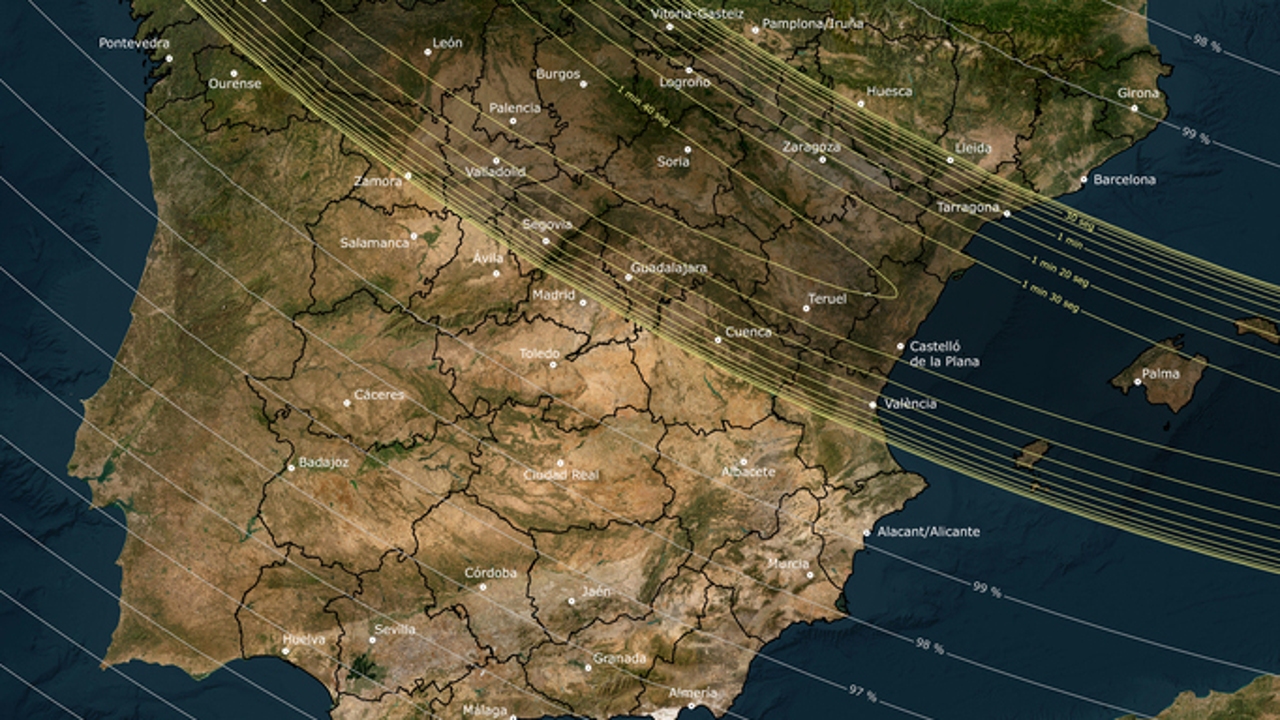
There are five months and 20 days left until the total solar eclipse on August 12. With it the train of solar eclipses will start which, one per year until 2028, will be visible from Spain. That day, at sunset, the Moon in its orbit around the Earth would come between it and the Sun until, for a couple of minutes, the afternoon would remain in total darkness because it would completely block the path of the Sun’s light to the Earth; Two minutes later and little by little, the light will return as the Moon continues on its path and leaves free passage to the light of the Sun, which will shine completely until it sets.
Certainly, although the Moon always revolves around the Earth and the Earth does the same with the Sun, an eclipse does not occur every day, but specific circumstances must occur. For this reason, in addition to being in themselves one of the most spectacular phenomena that Nature offers, total eclipses like the one next August are so impactful. And the fact that in the next two years there will be two more, one partial and one total, that all three will be visible from Spain, where a total eclipse has not been seen for more than a century, and that the Iberian Peninsula is precisely one of the very few inhabited places, and with infrastructure of all kinds, in the world through which the band of totality of the eclipse will pass (area of the territory from which the phenomenon can be seen in its entirety) adds that extra exceptionality that has scientists and astronomy fans expectantly awaiting those dates and some have been preparing for a long time to see the eclipse live and direct.
Spaniards and foreigners, and the forecast that several million people will travel to areas where the entire phenomenon will be visible. That is, to the communities of Galicia, Asturias, Cantabria, the Basque Country, Castilla y León, La Rioja, Aragon, Catalonia, Valencia and the Balearic Islands, from whose territories and in a maximum range of about 100 kilometers from west to east, the total eclipse can be seen. In the rest of Spain, on both sides of that area, it will be seen as partial: the Moon will only cover part of the solar disk.
A special eclipse
In reality, apart from what has already been said, for scientists, they all are. Whether total, partial or annular, they are the perfect opportunity to advance research and knowledge about the Sun, specifically its corona – the outermost part of its atmosphere – which normally cannot be seen without using specific instruments. For fans of astronomy and star tourism, a sector clearly on the rise in recent years, it is also an unavoidable event because the opportunity to see a total eclipse of the Sun is not frequent. In fact, the next one will not be until 2053. In short: the August solar eclipse is expected to have a great social impact. For this reason and for so many elements that make up this exceptionality, last year the Interministerial Commission was established to Coordinate Actions Related to the Trio of Eclipses, its official name, made up of 13 ministries and advised by a specific working group of the National Astronomy Commission.
Prepare the country for a total eclipse
When thousands and thousands of people, from the country itself or from abroad, are expected to travel to so many dispersed areas in different provinces, many needs and challenges arise and it is essential to take into account many and very diverse organizational aspects. Rigorous and truthful practical and scientific information will also be one of the basic needs to be met before the event. For this reason, the Cosmos Physics Center of Aragon (CEFCA) and the Association of Journalists of Aragon have held the First Meeting of Communication, Science and Society, with the title Astrojournalism: counting eclipses. These training days provided scientific and communication details to understand and contextualize the phenomenon of August 12 and the following ones.
“The country is already activated so that everything goes as it should and that the story we tell is one of emotions,” said Rosa Capeans, director of Scientific Culture and Innovation of the Spanish Foundation for Science and Technology (FECYT). Capeans explained how the Interministerial Commission of the Trio of Eclipses is working to identify and foresee all possible needs and prepare, organize and coordinate the actions of administrations in areas as diverse as mobility, health, security and dissemination. All the work carried out by this Commission, organized in six work groups – tourism and economic impact, public health, environment, prevention and civil protection, mobility and communication – will be translated into operational plans that will be carried out by the different administrations, central, regional and local, “with special attention to small towns that are not used to attending large events like this.” “It will be a very short event, but it will be live science,” he concluded.