
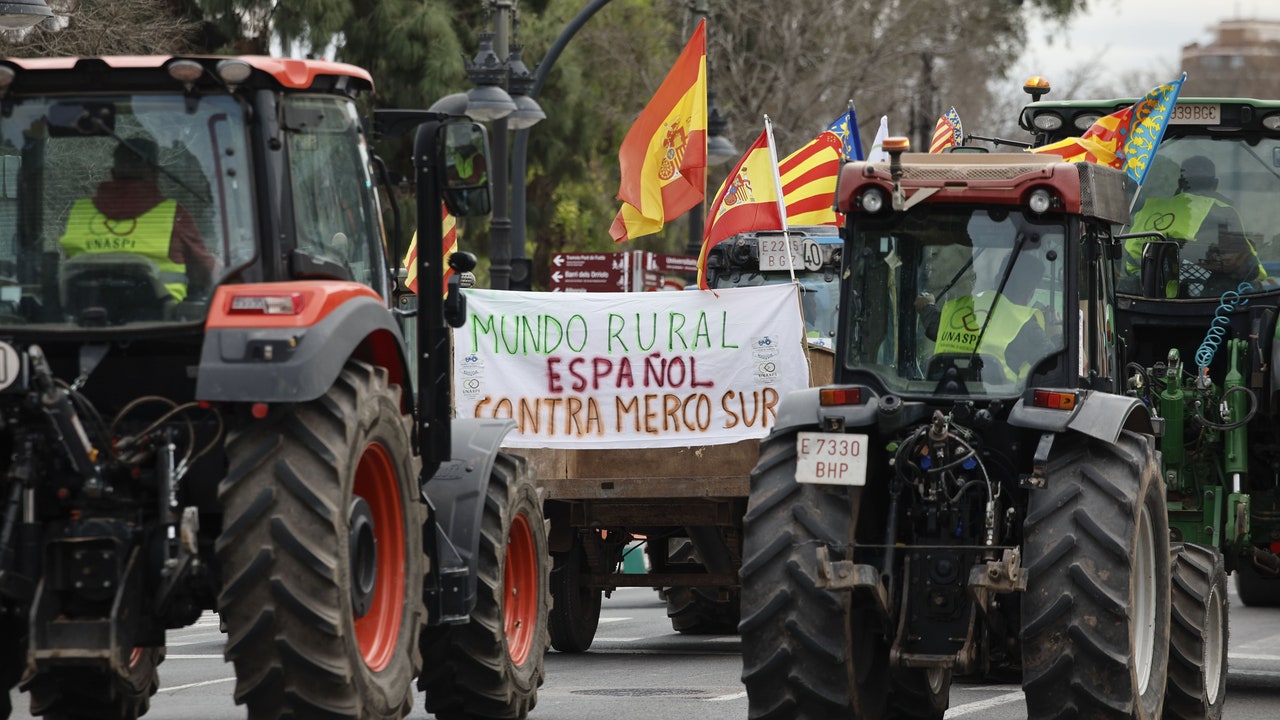
Just a few days after the signing of the agreement between the EU and Mercosurthe European Parliament has suspended its entry into force and has asked the Court of Justice of the EU to check whether the text conflicts with other agreements. The decision could take between a year and a half and two years to arrive, but in the meantime, the European Commission has pointed out the possibility and desire to provisionally apply the trade agreement and begin operating it despite Parliament. «The Council divided the agreement into two legal instruments: one for the associative (political) part and another for the commercial part, with the aim of expediting ratification and avoiding blockages. Their intention now does not seem very democratic to us,” explains Nando Durá, head of foreign trade at Unión de Uniones, one of the agricultural organizations opposed to the agreement. «For us, if everything related to the agricultural sector were eliminated it would be ideal. Basically for one reason: we have production standards that the third countries with which we sign do not have. They use phytosanitary products that are prohibited here, they have other animal welfare standards… not to mention, occupational safety,” adds Durá. «And it is not just Mercosur: we have already been carrying out agreements with South Africa or Morocco, and then India will come. The latter has just been signed, but at least rice, sugar, chicken meat or dairy products have been left out of liberalization.
The protests of the European agricultural sector have been a constant throughout the negotiation and everything indicates that they will continue. This week there have been rallies in several autonomous communities and on the 11th a large demonstration is planned in Madrid. In the rest of Europe, images of tractors in Brussels, Athens or Paris are common.
Farmers fear the importation of much cheaper products, with which they cannot compete and that do not meet the same environmental or quality standards. Of particular concern are beef, honey, rice or corn.
What does it consist of? In very summary, the EU-Mercosur agreement eliminates tariffs on European exports and goods imported from Mercosur by more than 90%. These reductions will be applied gradually over a period of 15 years.
In this trade balance, the countries of the Mercosur – Brazil, Argentina, Uruguay and Paraguay – provide food and critical minerals, while Europe exports capital and technology. The agreement benefits sectors such as the automobile, machinery, chemical or pharmaceutical industries and also opens public tenders from South American countries to European companies on equal terms, in infrastructure, digitalization or energy transition.
Safeguards
The final text, negotiated in extremis in recent months, incorporates a kind of “handbrake” to act in case the market harms European producers. The reduction in tariffs is offset by the establishment of quotas to avoid price drops in the EU. Thus, if a product registers an unusual price drop of more than 5%, the Commission could temporarily block the agreement and reinstate tariffs. The same would happen if the average of imports from Mercosur exceeds 5% for three consecutive years.
These new clauses have been well received by some agricultural unions, such as the Union of Small Farmers and Ranchers (UPA). “As a sector we cannot be oblivious to what is happening in the world, especially in such a complex geopolitical context and with the commercial difficulties faced by a country like Spain, with a clear export vocation,” explains Cristóbal Cano, general secretary of UPA. «That said, it is true that the agreement generates uncertainty and fear due to previous bad experiences with other trade agreements and due to the little dialogue maintained with the agricultural sector during these more than two decades of negotiation. However, thanks to the mobilizations we have achieved the highest levels of protection that the Commission has ever granted in a trade agreement: safeguard clauses, reinforcement of border controls, advances in reciprocity and audits in third countries to verify that what was signed is fulfilled. We want all this to be formalized as soon as possible and that it also serves to review agreements already in force or those to come, such as those of India, South Korea or Mexico,” he says.
The acceleration of the agreement in recent months has a lot to do with the geopolitical situation. When talks officially began in 1999, the international context was very different. Since then, the world has moved from globalization to trade war.
From globalization to the trade war
Global alliances are being reorganized and concern is growing in Europe about the need to diversify strategic partners, reduce dependence on China and confront the uncertainty coming from Washington. Hence the renewed interest in South America.
With the signing of the agreement The largest free trade area in the world is created, with 740 million citizens between the 27 countries of the EU and the four founding nations of Mercosur. For this reason, the delay is perceived as a setback from different areas: precious time that, if not recovered, could make any attempt at European positioning in Latin America and on the global stage disappear, for the benefit of China or the United States. Luisa Peña, director of the Euroamérica Foundation, considers that “this stoppage is a mistake. A delay of a year and a half or two years could mean that, by then, Mercosur will already be looking towards other regions, such as Asia, and will have closed agreements with other partners. The EU could lose even more weight, which would be very counterproductive in many ways: political, economic and commercial.
Ayes and noes
Spain has openly supported the agreement, despite criticism from the agricultural sector, and so has Germany. In the latter case, it is not surprising because One of the most benefited sectors is the automobile industry, that would access a market of millions of consumers without the 35% tariffs currently paid in Mercosur.
Italy, initially opposed, ended up voting in favor after the inclusion of elements such as safeguard mechanisms for sensitive products and the compensation fund to correct imbalances. Some media point to the Italian Government’s promise to reach 700,000 million euros in exports in 2027 – compared to the current 623,500 – as one of the reasons for the change in position.
Against it has always been maintained France; The large agricultural unions are especially active there and the presidential elections are approaching. Besides, The country has suspended the import of fruits produced with five substances banned in the EU.
The French measure inspires part of the European agricultural sector, which sees it as an example of the ways that could be explored to avoid problems. From Unión de Uniones they remember that “the safeguard clauses of previous agreements are usually placed above the volumes that are actually imported, so in practice they have no effect.” They also warn of the lack of inspections. «Every year fruit and vegetable analyzes are carried out in supermarkets and every year the remains of products not allowed in Europe increase. For example, in 2023 the supermarkets of the Valencian Community were reviewed and 60% of the batches of imported citrus fruits presented more residues of active materials than those recommended by the distribution chains themselves for Valencian citrus fruits.
This same week, La Unió Llauradora reported that the European food alert system detected at the end of 2025 a total of 949 rejections of fruit and vegetable products from third countries for containing active ingredients not authorized in the EU or for exceeding maximum residue limits. In 2024 there had been 892, which represents an increase of 6.5%.
The list is headed by Türkiye and Egypt, with 295 and 81 rejections respectively. Carles Peris, general secretary of La Unió, pointed out that “I understand less and less the European agricultural policies that benefit exporting countries and, however, lower inspection levels despite data on interceptions that are also public.”