
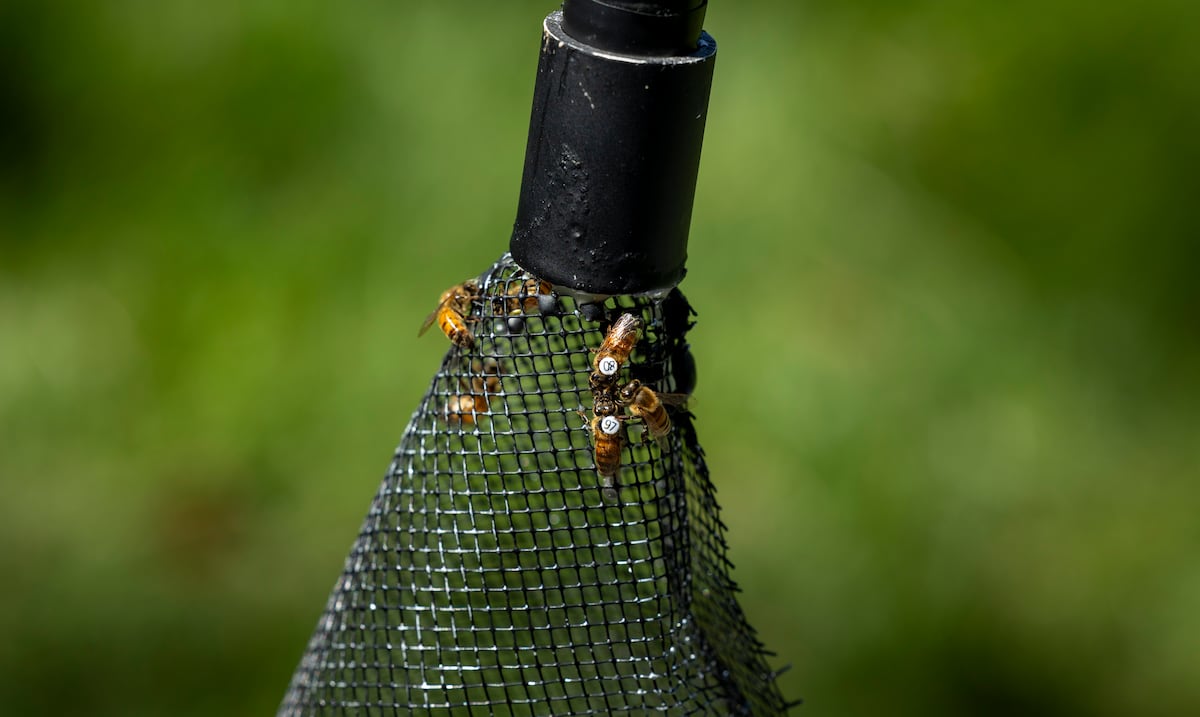
With a net of insects, Eliel Daniel Rivera O’Neill –known as the little beekeeper of Vieques– caught bees around the Secondary School of the University of Puerto Rico (UPR), in Piedras Riverwhere a group of teenagers arrived this Saturday to learn how to monitor these essential pollinators.
“They don’t scare me. It’s easy to grab them. They are pretty. They give us the fruits. Bees are important for the planet“, emphasized the 6-year-old boy, invited to the “Bee Hunting”, an initiative of Arecibo C3the new stage of the old Arecibo Observatory.
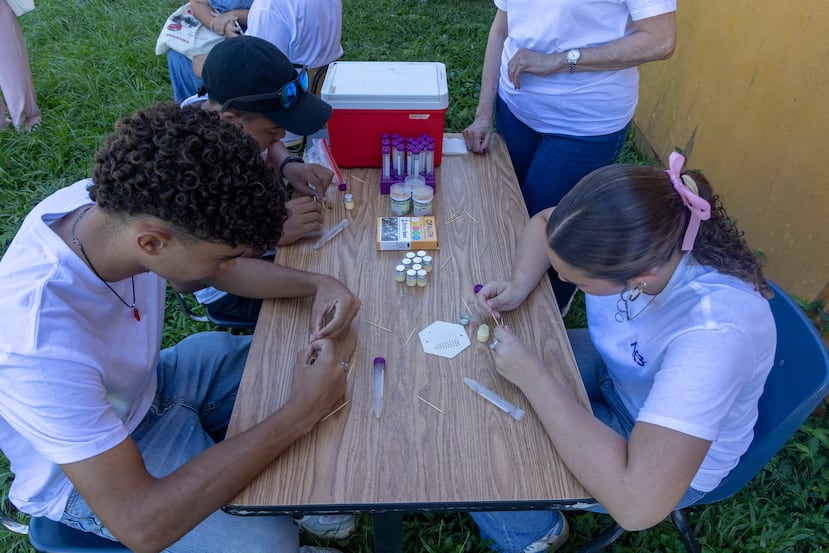
On the day, the young scientists recreated, in a single day, what they would normally do in 10, as a kind of “scientific marathon.”
From the data collection area, Ahinoam Bultron Vázquezfrom the Pedro Falú Orellano high school, recorded the entry of bees into a capsule. Using mathematical formulas, they all identified the bees, giving them numbers to differentiate them.
“It’s very different. I never thought I would be in a project like this, because I was afraid of them. I already know how to handle them when they hit me and, thanks to the project, I learned a lot of things from them”said the 16-year-old student.
The doctoral students of the UPR Ariana Rodriguez and Lizbeth Alvarado lead the field work of this research.
Rodríguez, research assistant at Arecibo C3, explained that students from five middle and high schools participate: Pedro Falú Orellano, in Rio Grande; American Military Academy, in Bayamon; Rosalina Caraballo de Martínez, in Catano; Monserrate León de Irizarry, in Red Cape; and the UPR Secondary School. Each group has dedicated around a week and a half to the initiative, working in different stages or stations where observation, measurement and data entry tasks are distributed.
The principal investigator of Arecibo C3, Jose Agosto, He explained that the project seeks to connect the skills of the branches of science, technology, engineering and mathematics (STEMin English) to the communities.
“We are developing an artificial intelligence model so that this data can then be automatically identified. We are applying all the different disciplines“added the biologist.
He explained that Arecibo C3 has set out to understand bees, create a census to identify wild hives and produce scientific research – with recommendations or good practices – to protect them. Agosto highlighted that the results can also be shared with other countries that, like Puerto Rico, have been affected by the climate change. He estimated that, after the passage of Hurricane Maria In 2017, the archipelago lost 80% of its hives.
More than 120 students from the five schools have already participated in the project.
Agosto also highlighted the “accessibility component,” by enabling a computer so that people with visual impairments can participate. “We made a data entry application adapted to her –Raysa Rondón Avilés, blind graduate student–. It is one of the best that collects data“, said.
The new STEM center, in the old Arecibo Observatory, is led by academic entities such as the UPR, in Río Piedras, the University of Maryland, in Baltimore; and the Cold Spring Harbor Laboratory, in New York. By spring 2026, the visitor center would debut, with a multi-sensory exhibit titled “Signs.”