
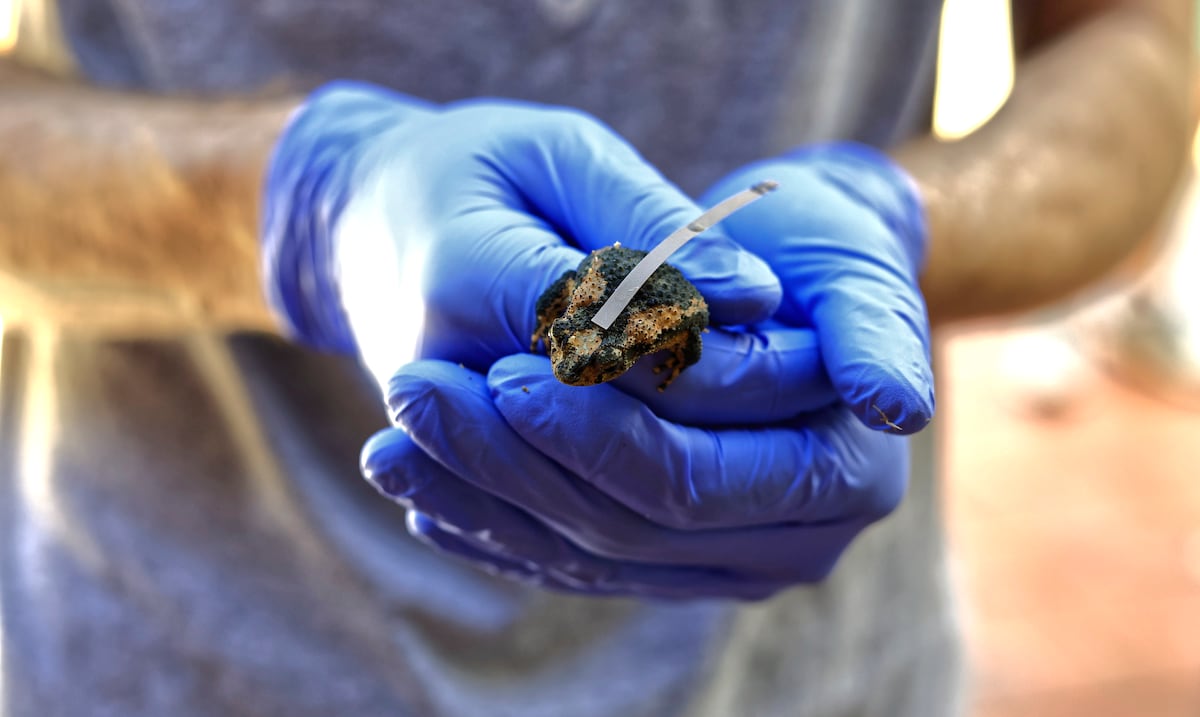
1/16 | The concho toad challenges the extinction of its species with its worldwide fame alongside Bad Bunny. The Puerto Rican concho toad (Peltophryne lemur, PRCT) is the only toad native to Puerto Rico and Virgin Gorda. – Thais Llorca Thais Llorca
Arecibo – He concho toadthe only endemic of Puerto Ricowho was catapulted to fame this year for his appearance in the documentary ‘I should have taken more photos’ of Bad Bunnyhas challenged its extinction as a species for more than forty years with reproduction assisted by herpetologists.
“The character of concho, through this Bad Bunny production, has become visible and to a certain extent has emerged from anonymity. It is a species that has always been part of the biodiversity of Puerto Rico, of our fauna,” explains to EFE Sondra Vegabiologist University of Puerto Rico (UPR) in Areciboin the north of the archipelago.
Charismatic for its upturned nose and famous for being the character who utters the phrase “Acho PR is something else,” this toad lives between six and eight years when in captivity and half that in its wild life, which is threatened by habitat loss, predators such as dragonflies and invasive species.
Vega, 53 years old and specialized in conserving this species, says that thanks to this exhibition of the character inspired by the peltophryne lemur, the scientific name of the concho toad, it has been possible to reach a wider audience to educate about this amphibian that has been fighting not to disappear since 1984, when a plan for its protection was initiated.
“That part of connecting with people had not been possible at the magnitude of what has risen this year,” says the herpetologist, amazed by the public’s interest when she was educating about this species during Bad Bunny’s residency.
The challenge of reproducing the concho toad in Puerto Rico
Abel Vale Nieves, president of the non-profit organization Ciudadanos del Karso, which has been part of this conservation effort since 2006 together with the UPR, the Department of Natural and Environmental Resources (DRNA), the federal government and fourteen American zoos, calls for a reproduction center for the concho toad in Puerto Rico to lower the cost.
“So far, reproduction is done in zoos in the United States and Canada and they are brought by plane in boxes, with water, they are given oxygen, everything necessary for them to survive and they are released in ponds,” Nieves tells EFE, before receiving nine scientists at his El Tallonal farm to release twenty adult and 106 juvenile specimens of these amphibians with radio transmitters.
In Tallonal, three artificial ponds were created for this species, which loves arid and semi-arid karst forests, especially in the south of Puerto Rico, and which reproduces intensely in short periods, mainly after heavy rains.
It is estimated that a female toad can release an average of one thousand to three thousand eggs in a reproductive event, although the maximum reported is fifteen thousand. With these conservation efforts, by June 2025, 751,938 tadpoles had been released, 58,983 of them in the summer season of the year.
A still unknown species
From Tallonal, Ramón Luis Rivera, technical advisor of the Ecology division of the DRNA, asserts that there is still a lot of work to prevent the concho toad from disappearing, since less than 5% of Puerto Ricans knew about it before its stardom with Bad Bunny.
“There is still a lack of knowledge, so keeping it in mind and being able to give people the opportunity to work directly in Puerto Rico would help us make people value it,” says Rivera, about the creation of the aforementioned first reproduction center for endangered species on the island.
The project was approved this week by the DRNA and all that remains is for the Permit Management Office to validate it to begin construction, which would last a year or a year and a half and would give, according to Rivera, “the opportunity for many students and people from the community to integrate and get to know the concho toad.”
So that more and more young people become interested in its conservation, Vega hopes that Concho will have a leading role in Bad Bunny’s international tour, which begins on November 21 in the Dominican Republic, and thus the species “leaves Puerto Rico” and achieves global visibility.