
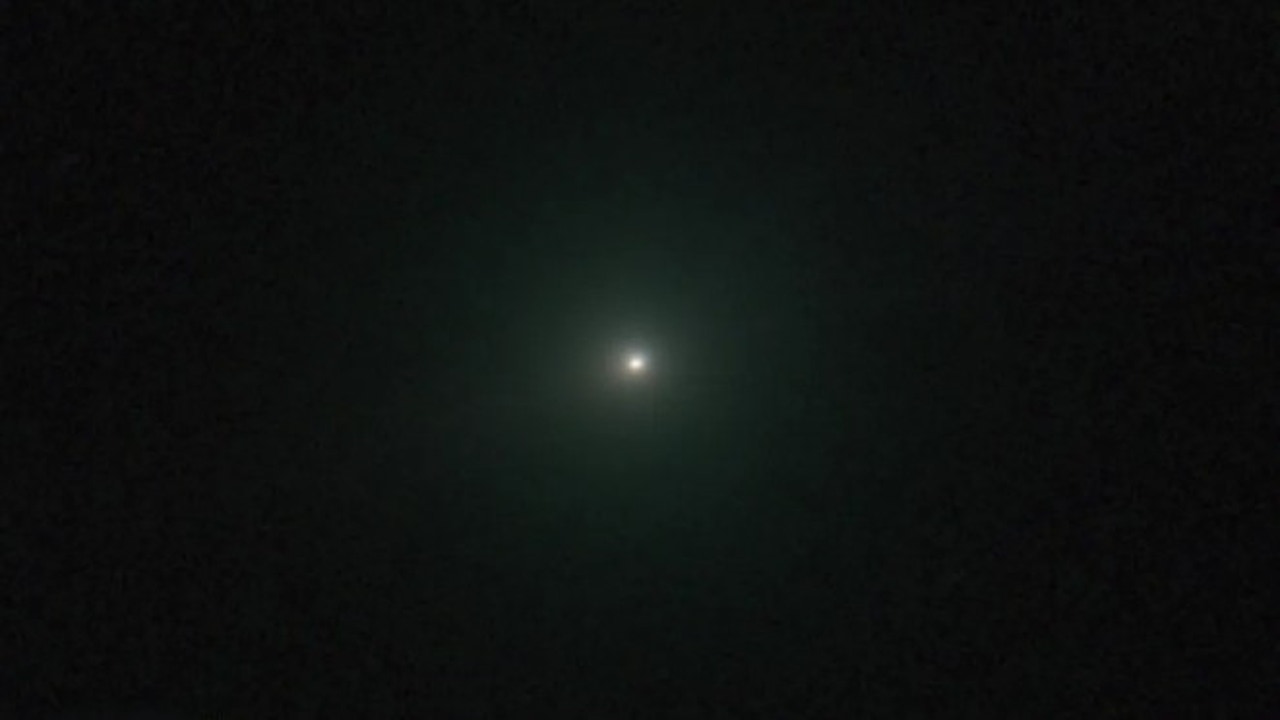
3I/ATLAS It is the third stellar body from outside the Solar system that is detected. Logically, this makes it an object of interest for scientists, astronomers and amateurs who follow its trajectory in detail, hoping to learn more aspects of its composition, origins and behavior, at times unusual, such as when it showed a temporary backlash. The latest news is a new image captured this Wednesday by researcher Qicheng Zhang with the telescope discovery of the Lowell Observatory.
The image has surprised because in it you can see a green glitter and the interstellar comet appears not have a tailbut it has an explanation that has nothing to do with the fantasies of the Harvard astronomer Avi Loebwho has been defending since this summer -3I/ATLAS was detected in July-, without losing seriousness, that 3I/ATLAS could be an alien spacecraft with hostile intentions, and finding a surprising echo in the media.
Returning to reality, the comets don’t always have a tail. This appears when the core becomes hot enough to sublime volatile; that is, when the ice and other materials from the comet go from solid to gaseous state when heated. This phenomenon occurs in the vicinity of the Sun – which is where, relatively, 3I/ATLAS is now located after reaching its perihelion -maximum approach to the Sun- the past October 29– and releases gases that astronomers can detect. As with most comets that approach the Sun, the comet’s tail appears brighter when viewed with a green filter.
Zhang used a filter to detect particles of diatomic carbon -C₂-which emit a green glow. He has pointed out that the comet contains many large molecules composed of carbon and hydrogen that fragment when the ultraviolet light of the Sun impacts them. When this occurs in a comet, some molecular fragments are reduced to two carbon atoms bondedthat is to say, diatomic carboneasily detectable by astronomers by the aforementioned green color of the light emission that the C₂ produced when excited by solar radiation.
It is the same phenomenon that took place in September, when a change in its brightness was detected, which went from reddish to greenish. Then it was observable without using a specific filter because the comet was more active and released more gases, but now the activity has decreased.
The second particularity of the imagethe absence of tailhas a simpler explanation. Just like Zhang has explained to the media Live Science, in reality the queue is still present. It can be seen a little brighter on the left side of the comet than on the right. This asymmetry is due to the fact that we are seeing the tail aligned with the nucleus and is left behind, curving slightly to the left. In other words, there is nothing extraordinary about the apparent absence of a tail.