
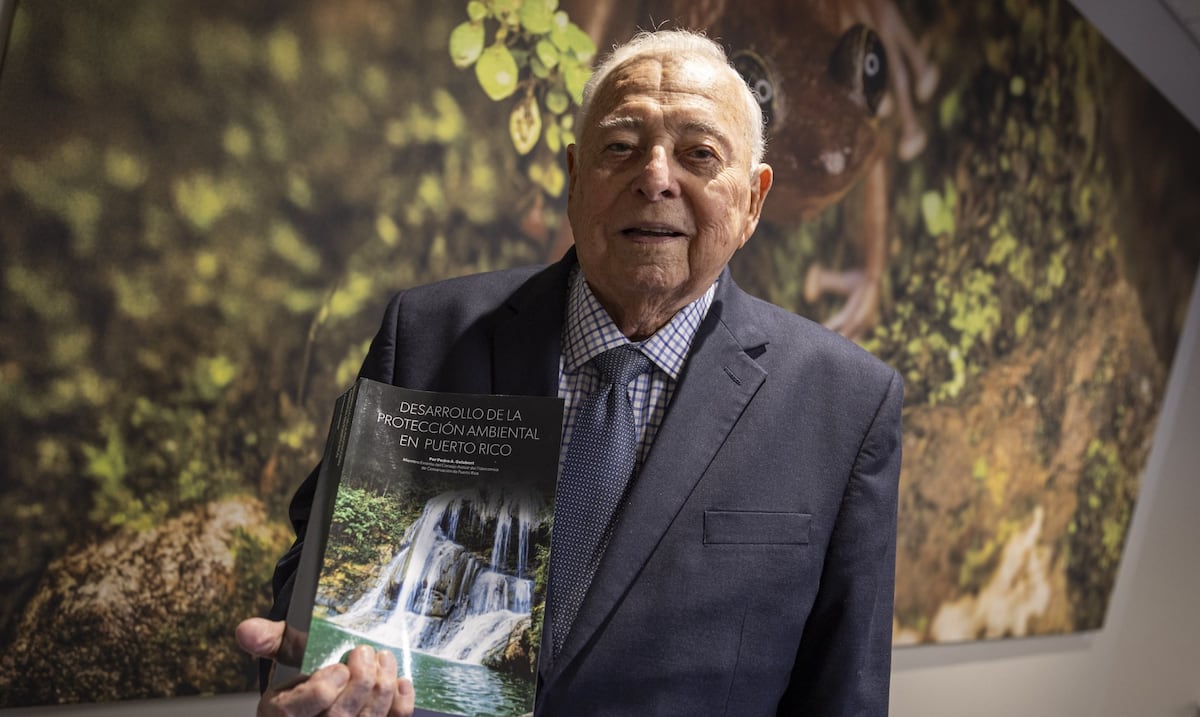
The renowned geologist Pedro Gelabert presented his new book that traces the history of environmental development in Puerto Rico, from its first inhabitants – the indigenous communities – to the present, highlighting the achievements, challenges and the path towards a sustainable development.
Titled “Development of environmental protection in Puerto Rico,” the book highlights that, over the centuries, The indigenous, Spanish and American cultures exerted significant influence on the fragile tropical ecosystem of the archipelago, whose limited resources were subjected to various pressures..
During the presentation, on Wednesday, at the organization’s headquarters For Nature (PLN), in Old San Juan, Gelabert explained that, during the indigenous era, the human environmental impact was almost negligible. However, during the eras of Spanish domination and American culture, there were deforestation massive due to agricultural and urban expansion, altering the natural balance.
The process even intensified with population growth and reached its most critical point during the industrial boom after the Second World Warcausing severe environmental crises, including river pollution, habitat disappearance and resource deterioration.
For Gelabert, during the 1960s, Puerto Rico developed a “strong” socio-environmental consciousness. Citizens began to demonstrate against the pollution of air, water and land, facing the presence of solid waste in mangroves, hollows and abandoned land. This crisis prompted, for example, the creation of organizations such as the Citizens Committee on Natural Resources and the Legislative Commission on Natural Resources, Beauty and Ornament.
1/8 | Ocean Eagle disaster: the spill that impregnated San Juan Bay with oil 57 years ago. On March 3, 1968, at 7:00 am, the ship Ocean Eagle collided with the bottom of the entrance channel to San Juan Bay. – Supplied: Pedro Gelabert
In the book, the author highlights that one of the decisive events was the oil spill from the Ocean Eagle ship in 1968, which affected beaches, coastal waters and the San Juan Bayand motivated the formation of an institutional structure for environmental protection. This included the creation of the Undersecretary of Natural Resources, the Environmental Quality Board –the first environmental agency in the world–, in 1970, and later, in 1972, the Department of Natural and Environmental Resources.
The text also details how Puerto Rico, inspired by international events such as the Planet Earth Day and other environmental laws of the United States, strengthened its legal and organizational framework, achieving advances in regulation, conservation and sustainable management of resources.
Also, Puerto Rico’s participation in international programs, such as those of the United Nations and the Cartagena Convention, stands out, which are fundamental in the protection of natural areas, the management of emergencies due to hydrocarbon spills and the conservation of biodiversity in the Caribbean.
Despite the achievements, Gelabert explained, in the 21st century new challenges arose, such as the depletion of fossil fuelsthe transition to renewable energiesthe possibility of nuclear energy and the effects of climate change. Cases such as the Zoe Colocotroni ship spill and military practices in Vieques They marked legal and environmental milestones that still impact environmental policy and actions in Puerto Rico.

“The story that Pedro Gelabert presents in this book reminds us that the protection of Puerto Rico’s ecosystems has been the result of collective action and the commitment of generations who have understood the value of natural resources.. It is a work that invites us to reflect on what we have achieved and what we can still do for a truly sustainable future,” said the executive director of the Conservation Trust and president of PLN, Fernando Lloverasin a statement.
Sponsored by the Trust, the book is available at Nature Store and Amazon.