
Vladimir Putin announced this Sunday that Russia had successfully tried a new class of cruise missile that uses nuclear propulsion instead of conventional. After a launch on October 21, the 9M730 Burevestnik toured 14,000 kilometers, but, instead of following a ballistic trajectory like others capable of reaching comparable distances – the RS-28 Sarmatalso Russian, the DF-41 Chinese or LGM-35 Sentinel American-, flies at low altitude, between 50 and 100 meterswhich greatly complicates its detection and interception by air defense systems.
Another feature is its range and autonomy of flight thanks to nuclear propulsion. The RS-28 Sarmat and the DF-41 equal or exceed the 14,000 kilometers of the Burevestnik (Petrel or storm petrel, in Spanish), cataloged as SSC-X-9 Skyfall for the NATObut according to Valery Gerasimovchief of the Russian General Staff, the new cruise missile can ‘hit highly protected targets at any distance with guaranteed accuracy’ and has unlimited reach. This is because it does not depend on the amount of fuel it can be loaded with.
The Burevestnik was announced in 2018, along with hypersonic missiles Kinzhal and Avangard. According to Putin, Russian scientists told him at the time that this type of weapon would hardly be possiblebut has now completed ‘crucial testing’ and may be deployed in the future. Those engineers had reasons for their skepticism, given that there are no other nuclear-powered missiles.
Not even the United States, the largest military force on the planet, has them, which tried to develop it in the 1950s and 1960s and ended up canceling it. It was the Project Pluto.
Project Pluto wanted to create a new type of SLAM missile
Project Pluto began on October 1, 1955 and was directed by Dr. Theodore Merkleleader of the Livermore Laboratory’s R division, with support from the United States Air Force, the Atomic Energy Commission, and the Lawrence Radiation Laboratory. The research was carried out in a facility of about 21 km² in the testing area known as Area 401in the state of Nevada. The new category of missile would be called SLAMacronym for Supersonic Low-Altitude Missile or Supersonic Low-Altitude Missile.
The basic objective was to build a nuclear ramjet engine. That is, it could introduce cold air from the front, pass it over a nuclear reactor to heat and expand it, and expel it from the back to generate thrust. It was, apparently, the same principle that the Russians have adopted for their modern version. The main theoretical advantage of this system would be its enormous autonomy, given that it could fly for days or even weeks, far above the capabilities of a conventional missile.
The technical challenges and environmental problems of the SLAM missile that the United States could not solve
Although the concept worked on paper, it involved a series of technical challenges that ended up making it unviable. Merkle described them in a 1959 report titled ‘The Nuclear Ramjet Propulsion System’.
The first major obstacle was reactor. Conventional nuclear reactors are large, heavy and shielded by tons of concrete. This should be just the opposite: light and compact enough to fly, but also capable of withstanding extreme pressures, brutal thermal variations and the forces derived from acceleration or turns of the missile. Each of these stresses alone could generate pressures of several thousand pounds per square inch.
Merkle’s reports did not differ much from those that Soviet scientists had written two years earlier. They both agreed that there were no materials capable of withstanding reactor temperatures, and the nuclear ramjet engine would need a second propulsion system for takeoffwhich added even more complexity to the design.
The list of obstacles was so extensive that Merkle identified ten major areas of research and development essential to make that engine viable.
Curiously, What seemed to worry him least was the radiological impact. In his calculations, a reactor 490 megawatts would generate less than 100 grams of fission products, and only a small part of them would end up in the air.
Edwin Lymanacting director of the nuclear security project at the Union of Concerned Scientists, put those figures in context in an email to Defense One. He recalled that in the 1950s, when nuclear powers were still carrying out atmospheric tests, ‘there wasn’t much concern about releasing additional radioactivity into the environment’. Today the perception is very different. Lyman also warned that talking about radioactivity in grams is misleading: ‘Chernobyl released just a few hundred grams of iodine-131 and caused thousands of thyroid cancers in children’.
And that’s without going into the effect of the flight itself. The Project Pluto missile, if deployed, would have flown at ground level and three times the speed of soundas the historian explained Gregg Herken in 1990 in Air & Space Magazine. That ‘Flying Chernobyl’ It would produce a 150-decibel roar, a lethal shock wave, and likely scorch the ground in its wake with the reactor blazing hot.
The Tory II-A and Tory II-C prototypes
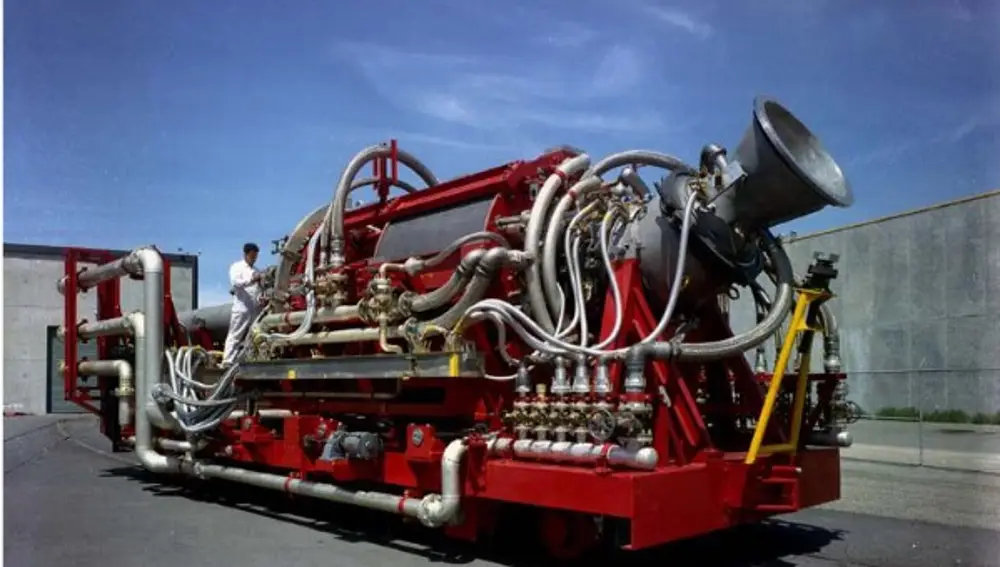
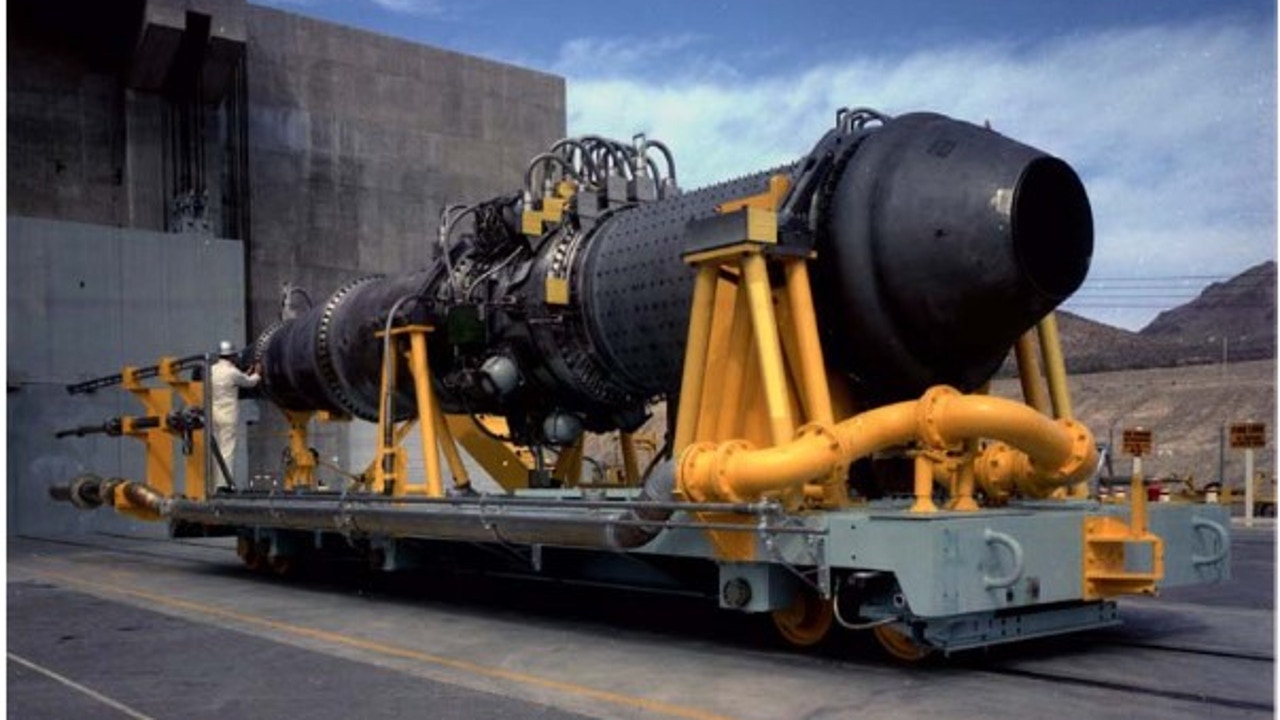
Despite everything, the program remained active for nearly a decade and Two prototypes of the missile reactor were built. The first, on scale and called Tory II-Awas the test prototype and carried out a test on May 14, 1961 in which it worked for a few seconds. It served to verify the core design and the integrity of the fuel elements under simulated ramjet conditions.
The second, already in real size and called Tory II-Cwas tested on May 20, 1964. It ran at full power – around 513 thermal megawatts – for 292 seconds and it was verified that the heated air flow generated the thrust predicted for an operational nuclear ramjet.
Despite the success of these tests, the program it was canceled in May 1964 for environmental, strategic and budgetary reasons and the likelihood that it would end up becoming a political problem. For example, where could a nuclear reactor be tested in flight? A mistake in Nevada could end up devastating an entire city. It was even considered to secure the missile with a cable or test it over the Pacific and then sink the reactor, but these plans were considered unviable.
There was also the risk of provoke a new arms race. A missile capable of flying for days, dropping nuclear bombs and spreading radiation would have been a powerful incentive for Moscow to develop its own.
And so we come to the present. The technical difficulties and risks remain the same. For this reason, many experts doubt that the current Russian nuclear propulsion project is really functional and believe that it is more a political pressure tool than a real technological advance.