
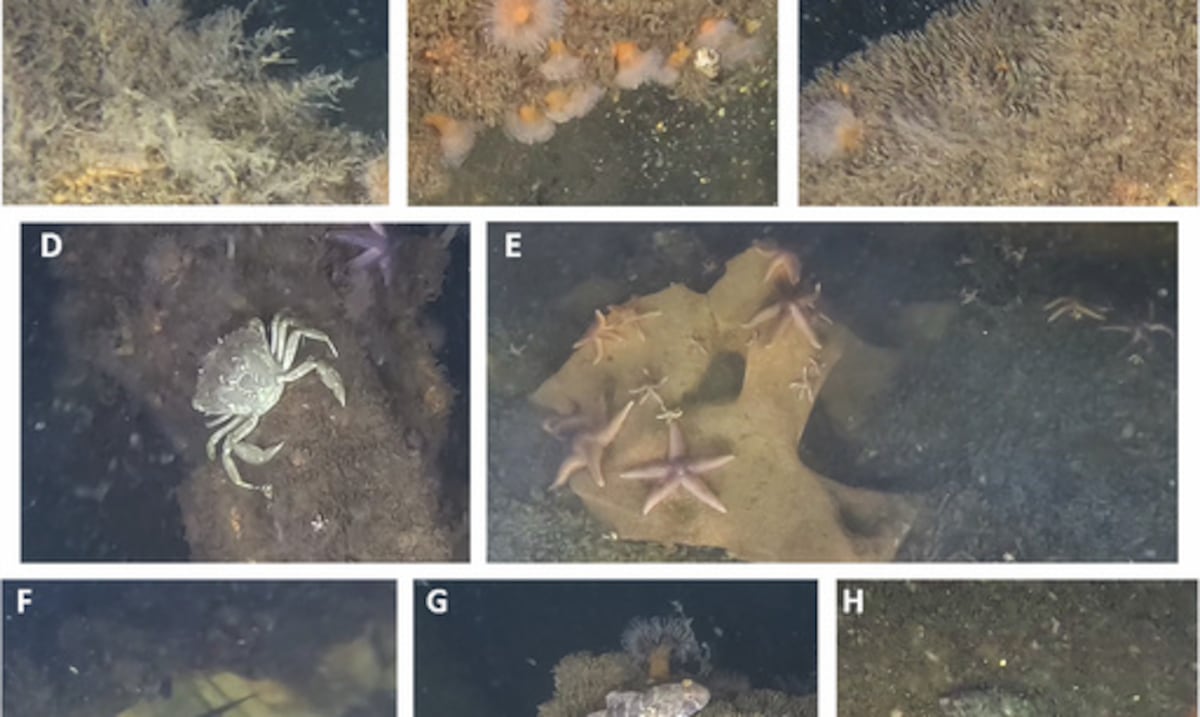
New York – An submarine submersible has discovered crabs, worms and fish that prosper on the explosive surfaces of World War II that were believed toxic to marine life.
In an old weapons deposit in the Baltic Sea, scientists found more creatures living on the eyelets than in the surrounding seabed.
“We were prepared to see significantly minor numbers of all kinds of animals,” said the author of the study, Andrey Vedenin, of the Subkenberg Research Institute in Germany. “But it turned out to be the opposite.”
Past conflicts have left their mark on the oceans of the world, Edenin said. Only German waters contain around 1.6 million tons of weapons thrown, mainly from the two world wars of the twentieth century. Disputed relics can contain nuclear and chemical remains, as well as explosives such as TNT.
It is the most recent example of wildlife that blooms in contaminated sites. Previous investigations have shown that shipwrecks and former weapons complexes are full of biodiversity.
In the new study, the researchers filmed anemonic networks, sea stars and another underwater life in Lübeck bay, off the coast of Germany. They were on the stalker in pieces of V-1 flying pumps used by Nazi Germany.
“Normally, one does not study the ecology of the bombs,” said James Porter, an environmentalist from the University of Georgia, who did not participate in the research.
The research was published on Thursday in the journal Communications Earth & Environment.
Why would marine creatures make their home in contaminated weapons? They could be attracted to hard surfaces, which are scarce in the Baltic Sea. The seabed is mainly a flat and sandy bed because the stones and rocks were extracted from the water for construction in the nineteenth and twentieth centuries, Vedenin said.
The area is also quite isolated from human activity due to chemicals, creating a somewhat protective bubble so that creatures thrive despite some toxic compensation.
Scientists expect to calculate how much contamination was absorbed by marine life. Another important step is to see what happens after creatures settle and if they are able to reproduce, Porter said.
Studies like these are a testimony of how nature takes advantage of human leftovers, changing the script to survive, said David Johnston, Marine Conservation Biologist at Duke University. Recently he drew a map of sunken ships from the First World War that have become habitats for wildlife along the Potomac River in Maryland.
“I think it’s a really great testimony of the strength of life,” said Johnston.