
A pink color flash crosses the muddy surface of the Amazon river While scientists and veterinarians – methods to the waist in the current – patiently place a mesh network around a group of toninas or pink dolphins of the Amazon. They are closing with each return, and a silver fish bank shines under the strong sunlight when they jump to escape from the network.
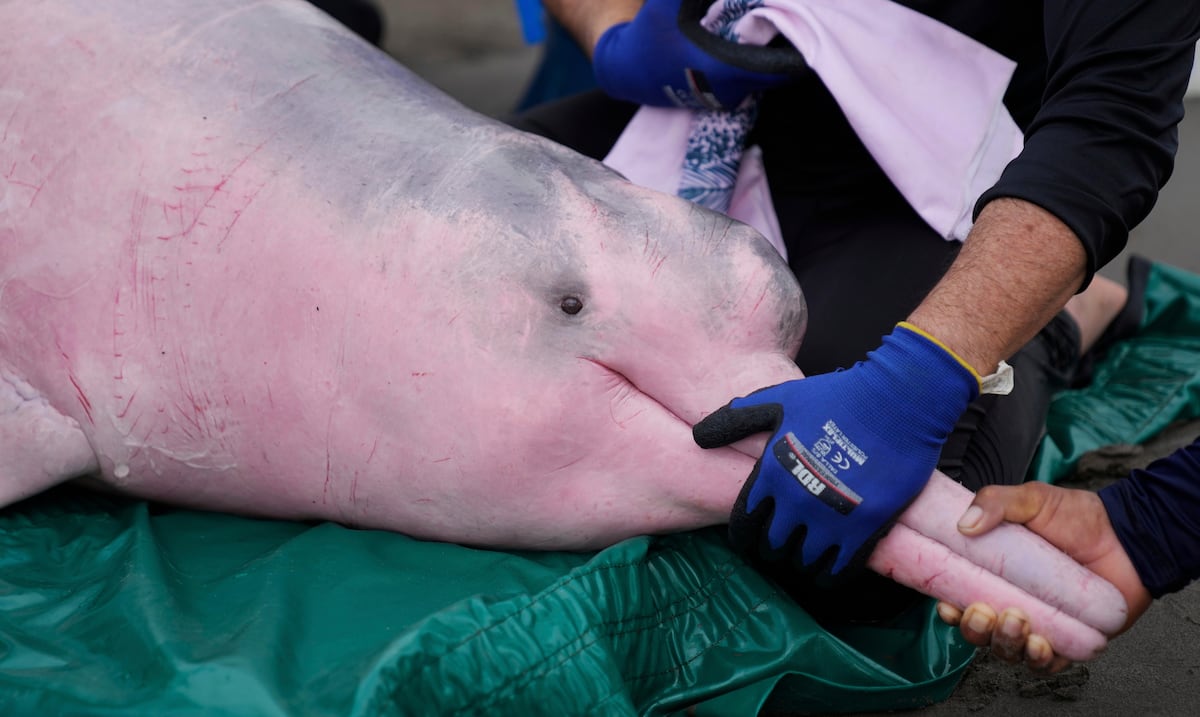
When the equipment goes up to one of the dolphins to a boat, it struggles while the water slips down its sides of pink and the crew transports it rapidly to the sandy shore of the river, where adrenaline -loaded researchers take it to a mat. They have 15 minutes —The maximum time that a dolphin can be out of the water – to complete its work.
Fernando Trujillo, the marine biologist who leads the tasks, kneels next to the animal’s head and covers his eye with a small fabric so he does not see what happens. He puts his hand gently on the animal and speaks in low tones.
“They have never felt a palm of one hand. So when we put the palm of the hand … we try to calm them,” said Trujillo, who wore a scarf with pink dolphins of the Amazon. “Really getting a dolphin out of the water is a kind of abduction.”
A person counts the breaths of the dolphin. Another moistens your skin with a sponge, while others perform multiple medical tests that will help show how much Mercury circulates through the most majestic predators of the Amazon.
It extends through the food chain
Trujillo directs the Omacha Foundationa conservation group focused on aquatic wild life and river ecosystems, and leads the health evaluations of the Rio Dolphins. It is a thorough operation that involves experienced fishermen, veterinarians and local people, requires months of planning, and occurs a couple of times a year.
“We took blood samples, we take fabric samples to evaluate mercury,” Trujillo told The Associated Press in the city of Puerto Nariño, on the Colombian banks. “Basically we are using dolphins as sentries of the river state.”
Mercury pollution is mainly due to illegal gold mining – a growing industry throughout the Amazon basin – and deforestation, which drags the mercury that is naturally found on the ground towards water courses.
The miners use mercury to separate the gold from the sediment and then throw the mud to the rivers, where it is introduced into fish that are later ingested by people and dolphins. The increase in world gold prices has promoted a mining boom, and mercury pollution on remote river roads has increased.
Mercury damages the brain, kidneys, lungs and immune system, and causes humor changes, memory loss and muscle weakness in people, according to the World Health Organization and the Environmental Protection Agency (EPA, in English).
Pregnant women and young children are in the greatest danger, and prenatal exposure has been linked to delays in development and a reduced cognitive function.
“The maximum that a living being can or should have a milligram per kilogram,” Trujillo said. “And here we are going through 20, 30 times as much as it should have.”
In previous years, his team found 16 to 18 milligrams of mercury per kilogram in dolphins, which may suffer the same neurological damage, deterioration of organs and other problems as humans. In it Orinoco River From Colombia, the levels in some dolphins have reached up to 42 milligrams, levels that scientists report that they are among the most extreme registered in the species.
Trujillo reported that it is difficult to demonstrate that mercury – which is a toxic element – directly kills the dolphins. More studies are conducted, he added, and pointed out that any mammal with a large amount of Mercury will die.
When Trujillo and his team tested their own blood three years ago, their results showed more than 36 times the safe limit: 36.4 milligrams per kilogram, a level that attributes to decades of working in areas affected by mercury and a diet that consists a lot of fish. With medical assistance, their level. They have decreased to approximately 7 milligrams.
“Mercury is an invisible enemy … Until a sufficient amount accumulates it will begin to affect the central nervous system”Trujillo told AP after his team managed to capture four pink Amazon dolphins and test them. “We are already seeing evidence in indigenous communities.”
A series of studies and scientific reports – including the work of the International Pollutants Elimination Network (International Network for Pollutant Elimination) and academic researchers – have found high exposure to mercury between indigenous peoples throughout the Amazon, included in Brazil, Peru, Colombia, Surinam and Bolivia. Hair samples revealed averages well above the secure threshold of 1 part per million – and a Colombian community registered more than 22 milligrams per kilogram.
The population collapses
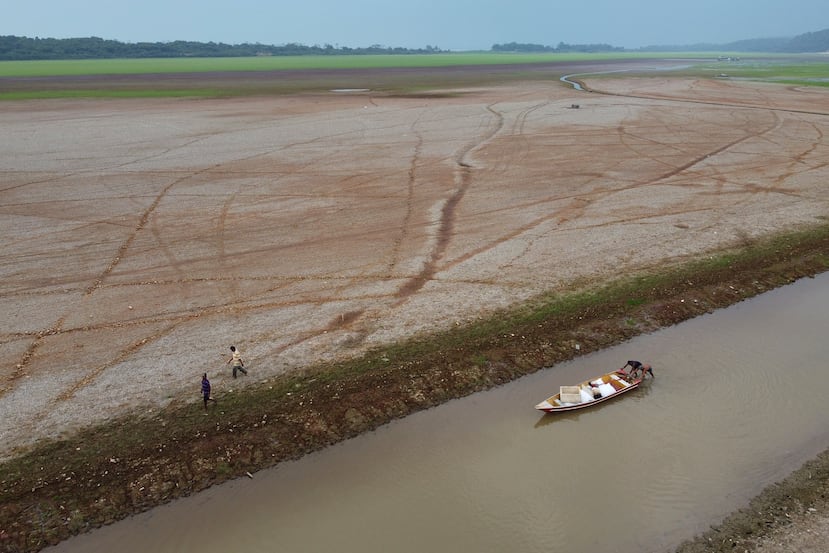
The populations of Delfines de Río in this part of the Amazon have collapsed, and Trujillo monitoring It shows a decrease in the last decades of 52% in the pink dolphins of the Amazon and a 34% drop in the gray buffersa different species of river dolphin. The International Union for the Conservation of Nature listed the Pink Dolphin of the Amazon as in danger of extinction in 2018. Trujillo said that the exact figures for the Amazon are unknown, but their organization estimates from 30,000 to 45,000 throughout the basin.
The Pink Dolphin of the Amazon also faces other threats, such as overfishing, river traffic, habitat loss, being entangled in fishing networks and prolonged drought.
Colombia says that it fights illegal mining and contamination by mercury. It prohibited the use of mercury in mining in 2018, ratified the Minamata Agreement – which aims to reduce mercury in the environment – and presented an action plan in 2024. The authorities highlight joint operations with Brazil and police operations, but surveillance agencies say that efforts are still unfortunate and that illegal mining persists in much of the country.
Other Nations of the Amazon report that they have redoubled efforts. Brazil has launched raids and taken measures to restrict the satellite Internet used by illegal golden gold camps used by Mercury, in order to interrupt their logistics and supply lines. Peru He recently seized a 4 tons of smuggling mercury. Ecuador, Surinam and Guyana have presented action plans to reduce the use of mercury in small -scale gold mining.
Dolphin tests safely
The operation to test the dolphins depends on José “Mariano” Rangel, a charismatic vendor of Venezuela. He leads the load when the time comes to climb the animals – which can weigh up to approximately 353 pounds – to the small boats. It is a moment that can end with a strong blow in the jaw while the dolphins force to free themselves.
“The most difficult thing about capture is the enclosure of the dolphins,” Rangel said.
An portable ultrasound device scan the lungs, heart and other vital organs to detect diseases. The team reviews if there are respiratory problems, internal injuries and evidence of reproduction; He photographs the skin and scars of animals; Take samples with swabs of the spiracles and genital holes to perform bacterial crops, and also take tissue samples for mercury analysis. Microchips are implanted for researchers to identify each animal and avoid duplicating tests.
Omacha has documented antimicrobial resistance – bacteria that cannot be eliminated with common medications – and respiratory problems. It has also identified possible emerging diseases – as the papillomavirus – that could represent a risk for both dolphins and humans.
After a long morning of capture and to test the dolphins, the scientists return to a laboratory in Puerto Nariñ manateesas well as bones and skulls of dolphins and other animals. They analyze some samples, prepare others to send them to larger facilities, and at the end of the day they repair networks and fill kits to repeat all this at dawn.
For Trujillo, every capture, scanning and blood analysis is part of a major battle.
“We are one step of critical danger, and then, extinction,” said Trujillo.