
Wednesday dawn marked a turning point in the Russian war against Ukraine and in the security of the NATO eastern flank. Poland denounced an unprecedented violation of its airspace, perpetrated by Russian drones in the framework of a massive attack against Ukrainian territory. Warsaw described the incident of “Act of aggression”while their allies immediately activated the collective defense mechanisms, in what was the First demolition of Russian drones within a member country of the Atlantic Alliance. In parallel, the Polish authorities confirmed the finding of remains of an unknown missile and of Seven drones In different regions of the country, which increases concern about the scope of the operation.
As reported by the Ukrainian president, Volodimir Zelenski, Russia launched more than Ukraine more than 40 ballistic and cruise missiles and 415 dronesof which at least Eight Kamikaze Shahed drones They were deliberately directed against Poland. The air defense operation, which extended throughout the night, concluded around 06.00 GMT, when the operational command of the Polish Armed Forces announced that joint operations with their allies were over. The spokeswoman for the Ministry of Interior, Kinga Galecka, explained that the missile found could be a Polish projectile used to tear down drones, and confirmed that one of the first remains was located at 05.30 GMT in Mniszków, in the east of the country.
The repeated violation of the Polish airspace was described by the Warsaw Executive as a “Act of aggression”while Prime Minister, Donald Tusk, spoke of a “Probable large -scale provocation” by Moscow. “The situation is serious. Today no one can doubt that we must prepare for various scenarios,” Tusk said at an extraordinary meeting of the Council of Ministers, summoned of urgency to analyze the events. The Head of the Government stressed that the defense mechanisms previously worked and that Poland is prepared to repel new provocations or attacks.
The ally deployment was immediate. He Allied Air Command (Aircom) coordinated the defense operation, which had the outstanding participation of F-35 fighters of the Koninklijke Luchtmacht of the Netherlandsdeployed in Poland as part of the NATO Air Surveillance Mission. Warsaw publicly thanked this support, remembering that it is not the first time that allied aircraft help reinforce the security of the Polish sky during the russian mass attacks against Ukraine.
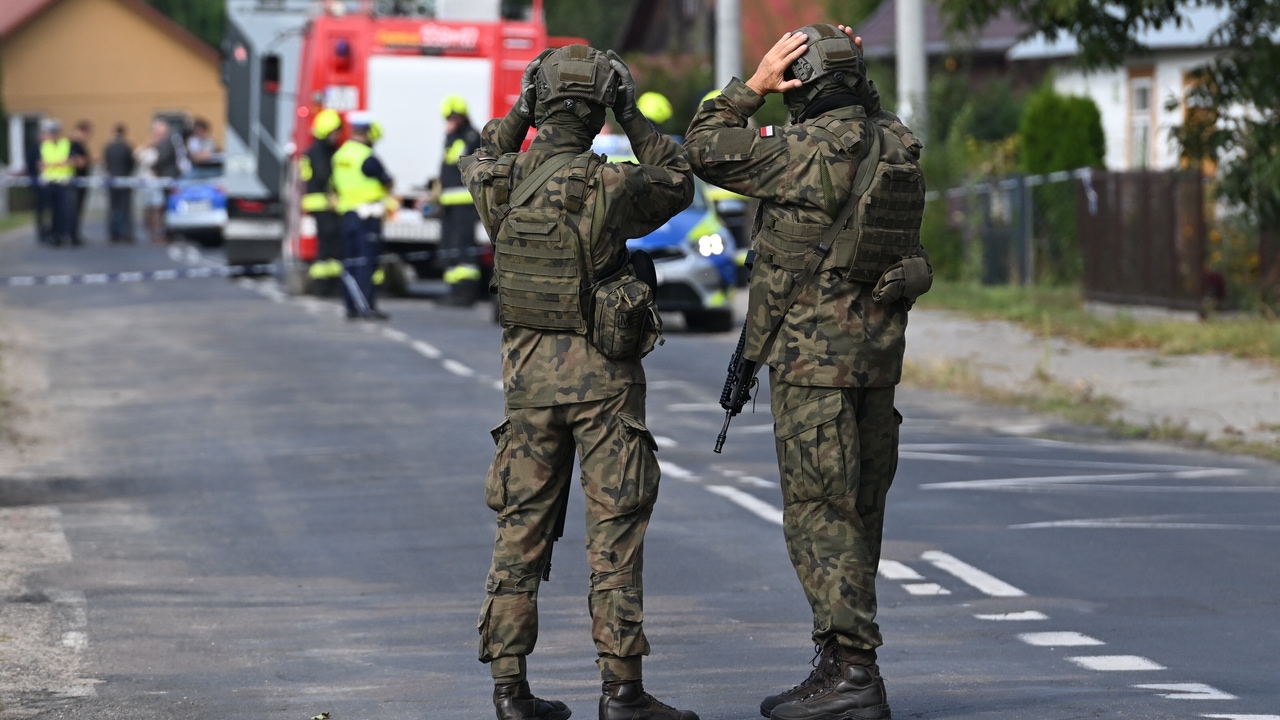
During the attack, Several Polish airports had to suspend operations and part of the airspace was temporarily closed. The Government confirmed that One of the drones fell on the roof of a residential building in Wyrykiin the east of the country, causing minor material damage. Local media also reported that the remains of another drone were found in the region of Lublinwhere they are being analyzed by the Armed Forces. Fortunately, no victims were recorded.
The population was alerted with precise instructions: Do not approach or touch fragments of fallen dronesbut immediately inform the authorities so that artificial patrols could ensure the area.
The High representative of the European Union for Foreign Affairs and Security, Kaja Kallashe said that they exist “Indications that suggest” that the incursion of Russian drones in Poland was intentional. “Last night, in Poland, we witnessed the most serious violation of European airspace by Russia since the war began, and the indications suggest that it was intentionally, not accidental,” he wrote on social networks. Kallas stressed that the That is fully solidarity with Poland And he warned: “The Russian war is intensifying, not ending. We must increase the cost for Moscow, reinforce support for Ukraine and invest in the defense of Europe.”
The international reaction was immediate. Allies like Sweden, Norway and Latvia They expressed their conviction and reaffirmed their commitment to the defense of Polish airspace. The Swedish Prime Minister, Ulf Kristerssonstressed that “Russian aggression against Ukraine is a threat to the security of all of Europe.”
Poland, meanwhile, maintained high -level contacts throughout the day. Tusk informed NATO general secretary, Mark Rutteto the United States Secretary of State, Mark Rubioand the Polish president, Karol Nawrocki. He also communicated with the Minister of Defense, Wladyslaw Kosiniak-Kamyszwhich was in London participating in a meeting with several European counterparts. The Polish Interior Ministry confirmed that all security forces are in Maximum alertcoordinating closely with the armed forces.
Emergency meeting in Warsaw
The severity of the attack forced a Emergency Meeting of the National Security Assembly. The government spokesman, Adam SzlapkaHe explained that the prime minister met with the ministers responsible for state security to evaluate the measures adopted and reinforce the preparation of the country to new threats. “The Polish airspace was raped by a huge number of Russian drones and those that meant a direct threat were demolished,” Tusk reiterated.
In parallel, the President of the European Commission, Ursula von der Leyenannounced a direct support measure to Ukraine: the creation of a “Drones Alliance” financed with 6,000 million euros from the European mechanism supported by the extraordinary benefits generated by immobilized Russian assets. “Europe will sign a drone alliance with Ukraine,” said Von der Leyen, stressing that this instrument seeks to strengthen kyiv’s defensive capacity against Moscow’s mass attacks.
The episode reinforces the perception that war is no longer limited to the Ukrainian territory, but that its effects extend dangerously towards neighboring countries. It is the first time that Russian drones are shot down within a NATO Member Statewhich makes this attack an unprecedented event. For Warsaw, the test has been successfully overcome thanks to cooperation with its allies, but at the same time it has made clear Europe’s vulnerability to the Russian military escalation.
In this context, the incident also raises questions about the future answer of the NATO. Although Poland did not formally invoked the Article 5 of the Washington Treaty, which provides for collective defense in case of armed attack against an ally, did use the expression “Act of aggression”marking a tone of maximum seriousness. The Atlantic Alliance, through its spokesman Allison HartHe confirmed that numerous drones entered the Polish airspace and were confronted by the joint defenses, in coordination with the general secretary Rutte and the Polish authorities.
The crisis has highlighted the growing importance of F-35 fighters deployed by allies in Eastern Europe, as well as the effectiveness of NATO integrated air and defense systems. It also highlights the close political and military cooperation between Poland, the European Union and the United States at a time of international uncertainty.
For Poland, the attack represents both a challenge and an opportunity. On the one hand, he exposes the country to direct risks derived from war in Ukraine; on the other, it consolidates its position as a centerpiece of European defensive architecture. In Tusk’s words, “this first test for the army, allies and prepared procedures has been overcome, and our plans are working.”
The day concluded with an alert feeling but also of Allied unit. Poland is not alone, and the rapid reaction of NATO and the EU proved it. However, the fact that Russia has dared to launch drones against a member country raises a new scenario: The war is getting closer and more to the heart of Europe.