
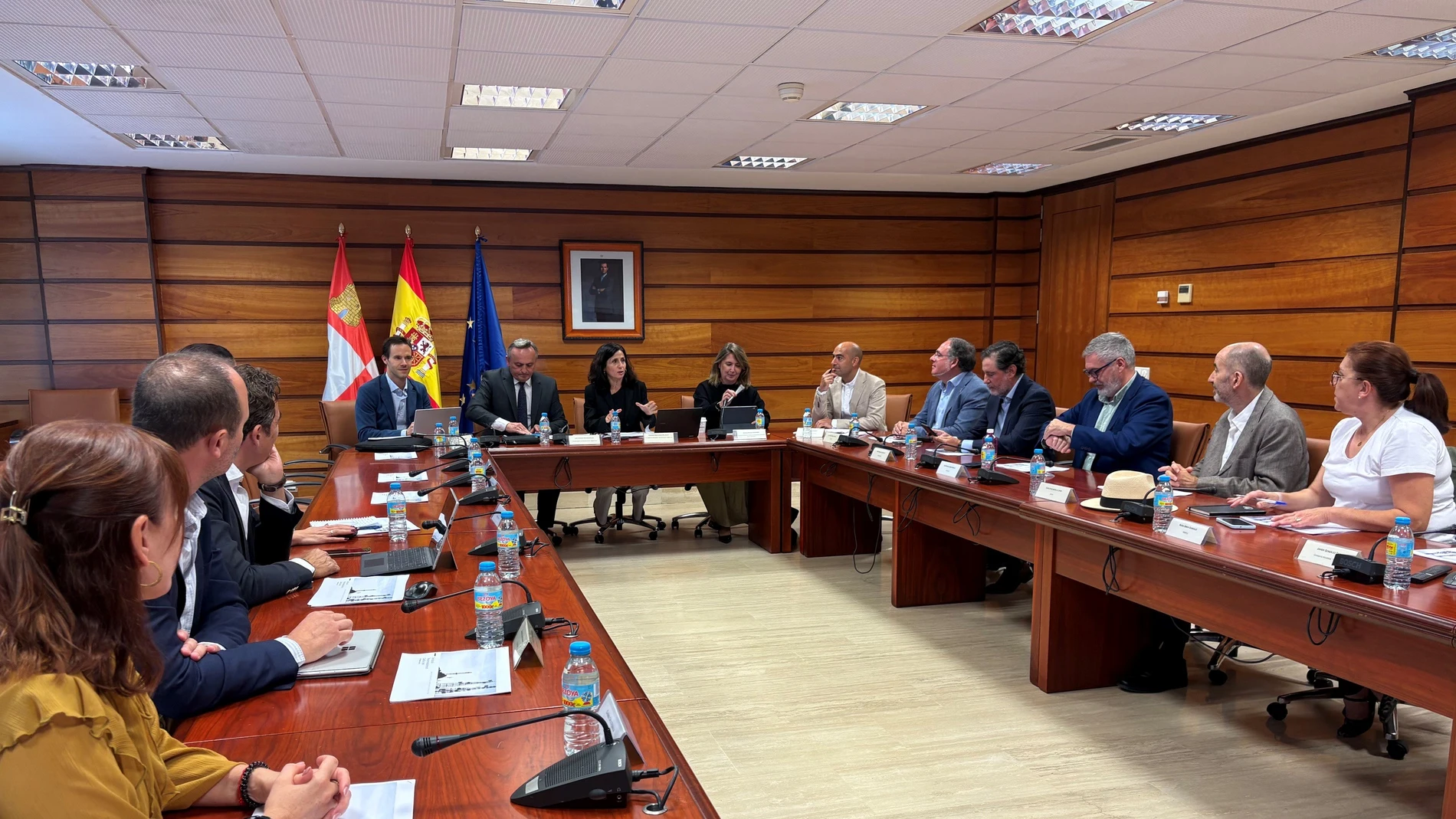
The Minister of Mobility, Digital Transformation and Artificial Intelligence, Cristina Sanchidrián, highlighted this Monday that connectivity constitutes an essential infrastructure for territorial cohesion, competitiveness and equal access to public and private services.
He did so after presiding over the Telecommunications and Digitalization Table of Castilla y León, which brought together the agents involved in the technical presentation about the infrastructure and connectivity to address the current situation, in what was the first meeting of this body that has been held in the current legislature under the presidency of Sanchidrián, who thanked the participation of operators, associations and representatives of the sector.
During the presentation, The update of the study carried out by the Ministry on fixed and mobile coverage was presented. The fixed coverage, which uses the latest information published by the Ministry, corresponding to June 2025, reflects a significant improvement compared to the previous diagnosis. However, the data confirms that the availability of connections of more than 100 Mbps remains uneven: the 14.15% of the municipalities of Castilla y León remain without coverage.
In terms of population, the situation is more favorable, although 4.46% of the population is still out of coverage. These results show that the advancement of the fiber is more easily concentrated where there is a higher population densitywhile in small municipalities the cost and complexity of deployments continue to make universal coverage difficult.
The counselor recalled the UNICO programs, developed with European MRR funds, have allowed progress between 2021 and 2025, but their execution in the fixed scope has been smaller and territorially unequal. The Ministry remains waiting for the Ministry to publish the final degree of execution of the completed programs and specify the new eligible areas and the actions necessary to achieve the European connectivity objectives in 2030 (gigabit and 5G for all populated areas).
Regarding the deployment of mobile broadband communications in rural areas, the ‘5G very rural networks’ program launched by the Government of Spain, which is currently the only plan in place to achieve the European objectives. It has an endowment of 17.9 million euros, of which only 1.4% of the total will fall on Castilla y León.
A figure of 267,000 euros that in the opinion of the counselor “is insufficient” because the community has more than 30% of eligible areas nationwide. A claim, he pointed out, that has been made “with little success to date.”
One in five centers continues without 4G coverage and almost six in ten lack 5G
The study of population centers once again reveals the territorial dimension of the mobile gap. 20.4% of the cores analyzed appear without 4G coverage or without sufficient data, which is equivalent to one in five. In 5G, the proportion rises to 59.64%, almost six out of ten cores. Although the incidence on the total population is lower, with 0.4% without 4G coverage and 4.72% without 5G coverage, the lack is concentrated precisely in the smallest and most dispersed settlements.
Road network analysis
The main novelty of the mobile coverage study is the expansion of the analysis of the entire road network of Castilla y León. The evaluation is no longer limited to the regional network and covers 33,778 kilometers of state, regional and provincial roads.
The results show a marked gap between the roadss of the General State Administration and the rest of the networks. In 4G there is coverage in 98.2% of kilometers of the state network, compared to 87.6% of the regional network and 56.3% of provincial roads. The difference is even greater in 5G: coverage reaches 70.7% on state roads, but drops to 18.2% on the regional network now only 4.6% on the roads of the provincial councils.
“The figures show that it is not enough to present high percentagesIt is coverage of the population. Connectivity must also reach the roads that connect the territory, especially those that connect small municipalities and rural centers,” the counselor stressed.
The regional road network, an opportunity to accelerate fiber deployment
Within the scope of its powers, the Ministry has presented a measure aimed at facilitate fiber optic deployment in parallel to the extensive network of autonomously owned roads.
As a novelty, it is intended to enable the new fiber optic installations to occupy the public road domain area of the Community’s road network. This action seeks to simplify processing, reduce obstacles and take advantage of existing corridors to bring high-capacity networks closer to rural areas.
The session was attended by telecommunications operators and representatives of entities in the sector.